
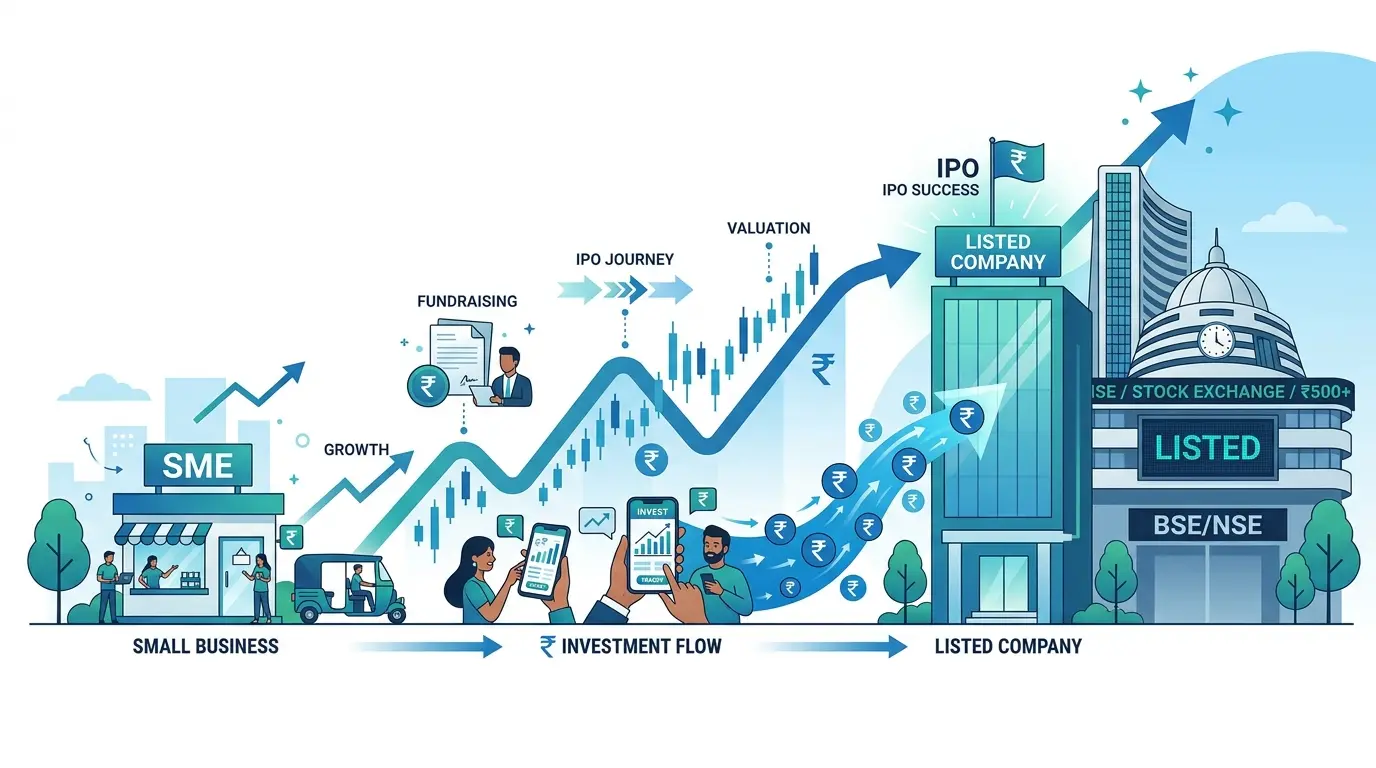
What is SME IPO? Meaning, How to Apply?
Introduction
Every week, a few small companies in India go public and their stocks double or triple on listing day. Retail investors chase those numbers. Most of them have no idea what they are actually buying into.
That is the problem with SME IPOs. The listing gains look incredible from the outside. But the full picture, the low liquidity, the weak disclosures, the GMP manipulation, the promoter games, is rarely talked about in the same breath.
India saw over 200 SME IPOs in FY2024 alone, raising thousands of crores from retail investors. Some of those companies went on to become solid long-term holdings. Others crashed 40 to 60% within three months of listing. The difference between the two is almost always visible in the prospectus, if you know what to look for.
This guide covers all of it. What SME IPOs are, how they work, how to apply, how to evaluate them, how allotment works, the tax implications, and the things most financial websites skip over because they are inconvenient.
What is SME?
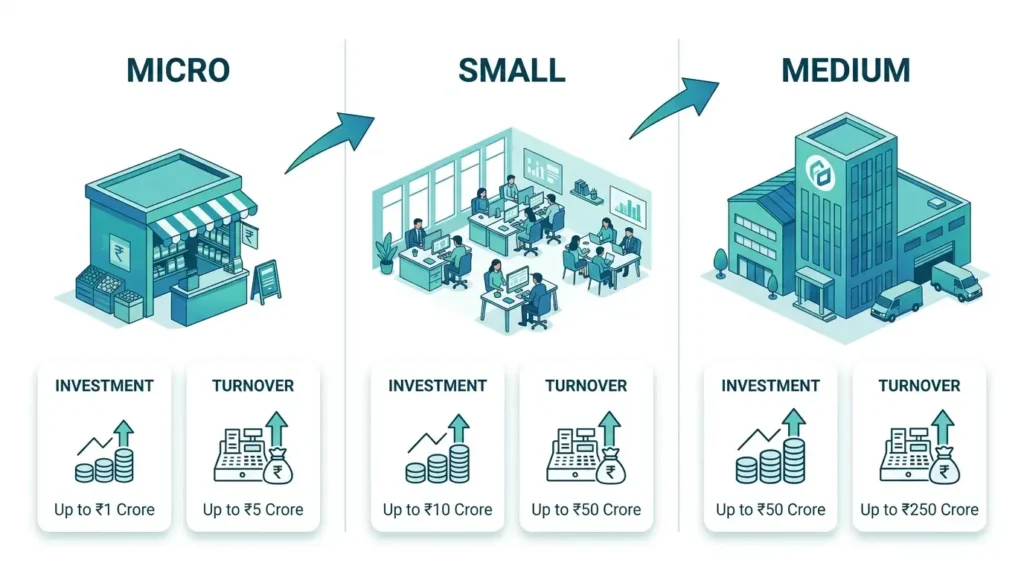
SME a.k.a Small and Medium Enterprise. In India, businesses are classified as SMEs based on their annual turnover and investment in plant, machinery, or equipment. The classification was revised in 2020 under the Atmanirbhar Bharat package, moving away from the old 2006 MSMED Act thresholds.
Here is the current classification as per the revised MSMED Act criteria:
Micro Enterprises
- Investment in plant and machinery or equipment: Up to ₹1 crore
- Annual turnover: Up to ₹5 crore
Small Enterprises
- Investment in plant and machinery or equipment: Up to ₹10 crore
- Annual turnover: Up to ₹50 crore
Medium Enterprises
- Investment in plant and machinery or equipment: Up to ₹50 crore
- Annual turnover: Up to ₹250 crore
This classification applies to both manufacturing and service enterprises. An enterprise that crosses the investment or turnover threshold for its current category moves to the next one automatically.
SMEs contribute roughly 30% of India’s GDP, employ over 110 million people, and account for about 45% of the country’s total exports. The government offers them several benefits including priority sector lending, subsidies, and now, direct access to the capital markets through dedicated SME listing platforms.
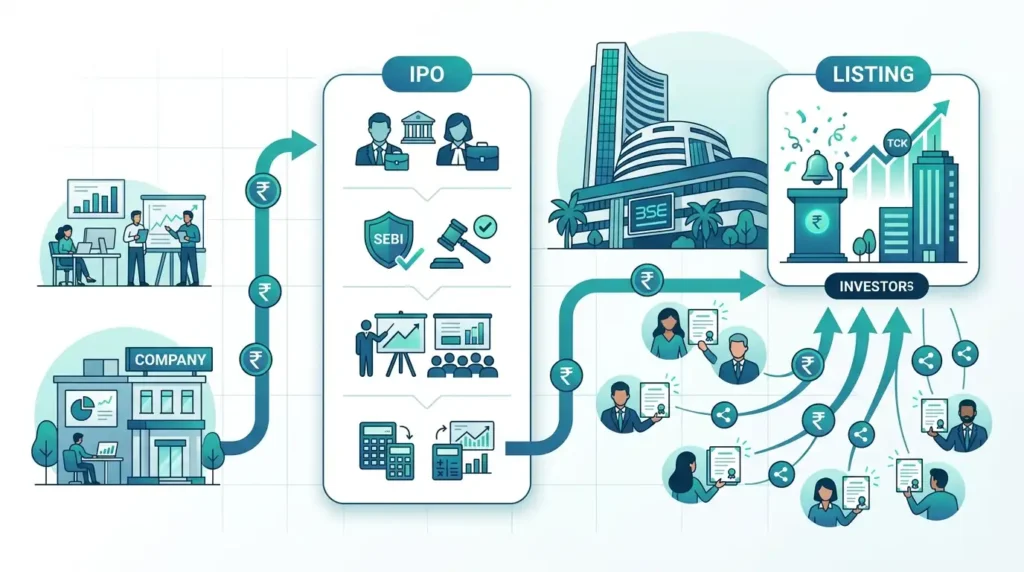
SME IPO meaning: An SME IPO (Small and Medium Enterprise Initial Public Offering) is the process through which a small or medium-sized company raises money from the public by issuing shares and listing them on a dedicated stock exchange platform built for smaller businesses.
Like any IPO, the company issues new shares to investors and uses the capital raised for business purposes such as capacity expansion, debt repayment, working capital, or acquisitions. What sets SME IPOs apart is that they operate under lighter eligibility requirements and list on separate exchange segments created specifically for smaller companies.
Large, well-established companies list on the BSE or NSE mainboard. Smaller companies list on BSE SME or NSE Emerge, which are dedicated segments within the same exchanges but governed by very different rules. The key difference from a regulatory standpoint: for mainboard IPOs, SEBI directly reviews and approves the Draft Red Herring Prospectus. For SME IPOs, that responsibility sits with the exchange itself.
Where Are SME IPOs Listed in India?
SME IPOs in India are listed on two dedicated platforms:
BSE SME is operated by the Bombay Stock Exchange. It was launched in March 2012 and is the larger of the two platforms by number of listings. As of 2024, BSE SME has over 500 companies listed on it, making it one of the most active SME exchange platforms in Asia.
NSE Emerge is operated by the National Stock Exchange of India. It was launched in September 2012 and works similarly to BSE SME. NSE Emerge has seen growing activity, particularly from technology and services sector companies.
Both platforms are overseen by SEBI through the exchanges, but unlike mainboard IPOs where SEBI directly scrutinises the DRHP, day-to-day verification and listing approvals for SME IPOs are handled by the exchange. That distinction matters more than most investors realise because it means the scrutiny applied to these companies is lighter.
Eligibility Criteria for SME IPOs
Not every small company qualifies for an SME IPO. Both BSE SME and NSE Emerge have specific requirements a company must meet. The common criteria include:
- Post-issue paid-up capital must be less than ₹25 crore. Companies with capital above this threshold are required to list on the mainboard.
- Net tangible assets of at least ₹1.5 crore as per the latest audited financial statements
- Minimum 2 to 3 years of operating track record with audited financials
- The company must have an operational website
- Shares must be offered and traded in dematerialised (Demat) form only
- The company must be incorporated under the Companies Act
- A positive net worth is required (company should not have negative equity)
- No winding-up petition should be pending in any cour
How to Apply for an SME IPO: Step-by-Step
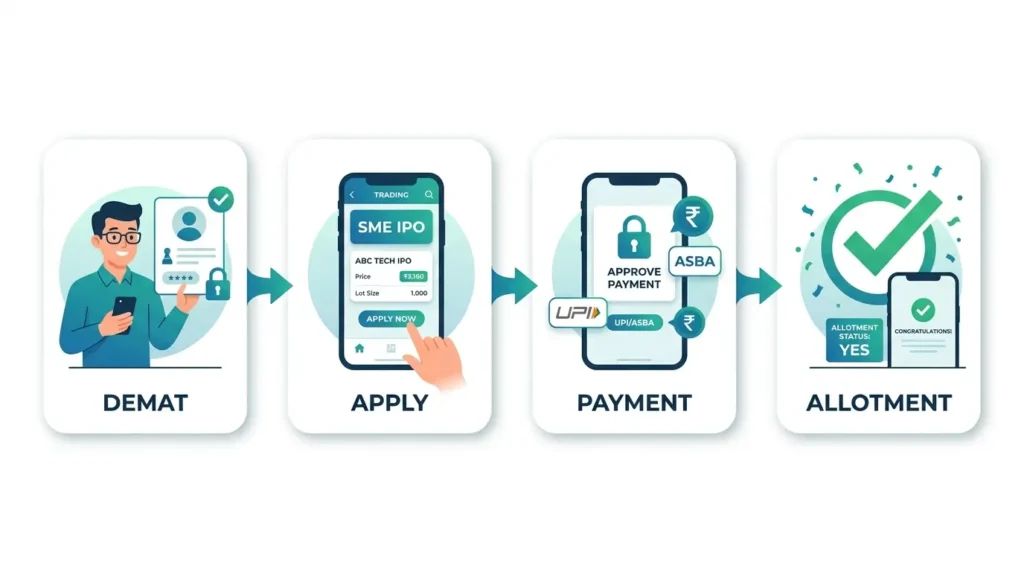
Applying for an SME IPO is similar to a regular IPO in process, but there are important differences that can catch new investors off-guard.
Step 1: Check the Lot Size and Minimum Investment
The minimum application size in an SME IPO is ₹1 lakh. This is deliberately much higher than mainboard IPOs, where you can apply for as little as ₹10,000 to ₹15,000. The high minimum is designed to ensure only investors with meaningful capital and higher risk tolerance participate.
The actual number of shares per lot varies by IPO. If the issue price is ₹50 per share, a lot might be 2,000 shares (₹1 lakh). If the price is ₹200, a lot might be 600 shares. Always check the lot size in the IPO prospectus or on your broker’s platform.
Step 2: Open a Demat and Trading Account
You need an active Demat account and a trading account with a SEBI-registered broker. Most major brokers like Zerodha, Groww, Angel One, ICICI Direct, and HDFC Securities support SME IPO applications. If you already invest in stocks or mutual funds, you likely have this set up.
Step 3: Know Which Category You Fall Under
SME IPOs divide investors into three categories:
- Retail Individual Investors (RIIs): Applying for up to ₹2 lakh total
- High Net-worth Individuals (HNIs) or Non-Institutional Investors (NIIs): Applying for more than ₹2 lakh
- Qualified Institutional Buyers (QIBs): Mutual funds, insurance companies, scheduled banks, and foreign portfolio investors
Unlike mainboard IPOs, the quota allocation across these categories can vary significantly in SME IPOs. Always check the specific allocation in the prospectus of the IPO you are applying for.
Step 4: Apply Through UPI or ASBA
UPI-based Application: Log in to your broker’s platform or a SEBI-registered app (Zerodha, Groww, Paytm Money, PhonePe, etc.), search for the SME IPO by name, select the number of lots, enter the bid price (usually cut-off price), and authorise using your UPI ID. The application amount gets blocked in your bank account until allotment.
ASBA (Application Supported by Blocked Amount): Apply directly through your bank’s internet banking portal under the IPO section. The bank blocks the application amount until allotment is finalised. No money actually moves until shares are allotted to you.
Step 5: Understand the Allotment Process
After the subscription window closes, the registrar processes allotments. SME IPO allotment works differently from mainboard IPOs in one important way.
In a mainboard IPO, at least 1,000 allottees are required. In an SME IPO, only 50 allottees are required. This means oversubscription is handled differently. Instead of proportional reduction (where everyone gets a smaller piece), SME IPOs use a lot-based lottery system. Either you get the full lot you applied for, or you get nothing.
If you get allotted shares, they appear in your Demat account within 2 to 3 business days of the listing date. If not, the blocked amount is released back to your bank account, typically within 1 to 2 business days.
Step 6: Listing and Trading
Shares list on BSE SME or NSE Emerge on the listing date specified in the prospectus. Trading starts from that day. There is an important difference here compared to mainboard stocks.
How to Check SME IPO Allotment Status
Once the subscription closes and the allotment is processed, here is how to check whether you received shares:
Method 1: Check on the Registrar’s Website Every SME IPO has a registrar (commonly KFin Technologies, Link Intime, or Bigshare Services). Go to the registrar’s website and look for the IPO allotment section. Enter your application number, PAN, or Demat account number to check your status.
Method 2: Check on BSE or NSE Website Both BSE (bseindia.com) and NSE (nseindia.com) publish allotment details. Go to the IPO section, find the relevant SME IPO, and check allotment status using your PAN.
Method 3: Check on Your Broker’s Platform Brokers like Zerodha, Groww, and Angel One show IPO allotment status directly in the app under the IPO section after the allotment date.
Method 4: Check Your Demat Account If shares are allotted, they will appear in your Demat account holdings on or before the listing date. You can check this through CDSL (mycams.com or cdsl.com) or NSDL (nsdl.co.in) portals.
Allotment results are usually announced 1 to 2 days before the listing date.
SME IPO vs Mainboard IPO: Key Differences
| Parameter | SME IPO | Mainboard IPO | ||
|---|---|---|---|---|
| Post-issue paid-up capital | Less than ₹25 crore | More than ₹10 crore | ||
| Minimum application size | ₹1 lakh | ₹10,000 to ₹15,000 | ||
| Minimum allottees required | 50 | 1,000 | ||
| DRHP reviewed by | Stock Exchange (BSE/NSE) | SEBI directly | ||
| Underwriting requirement | 100% mandatory | Partial underwriting allowed | ||
| Market making post-listing | Mandatory for 3 years | Not required | ||
| Secondary market trading | In lots only | Single share units | ||
| Financial track record | 2 to 3 years | 3 years (with exceptions) | ||
| Listing platform | BSE SME or NSE Emerge | BSE or NSE mainboard | ||
| Regulatory compliance | Lighter | Full SEBI compliance | ||
| Promoter lock-in period | Minimum 1 year | Minimum 3 years (for 20% of shares) | ||
| Quarterly reporting | Not mandatory | Mandatory |
A note on promoter lock-in: The lock-in for SME IPO promoters is only 1 year, compared to 3 years for 20% of the promoter’s shareholding in a mainboard IPO. This is a meaningful difference from an investor protection standpoint.
A note on market making: After listing, the merchant banker (lead manager) must provide buy and sell quotes for the stock continuously for 3 years. In practice, this keeps the stock from going completely dark, but it does not guarantee a fair exit price. The market maker is under no obligation to match your desired selling price.
How the SME IPO Listing Process Works
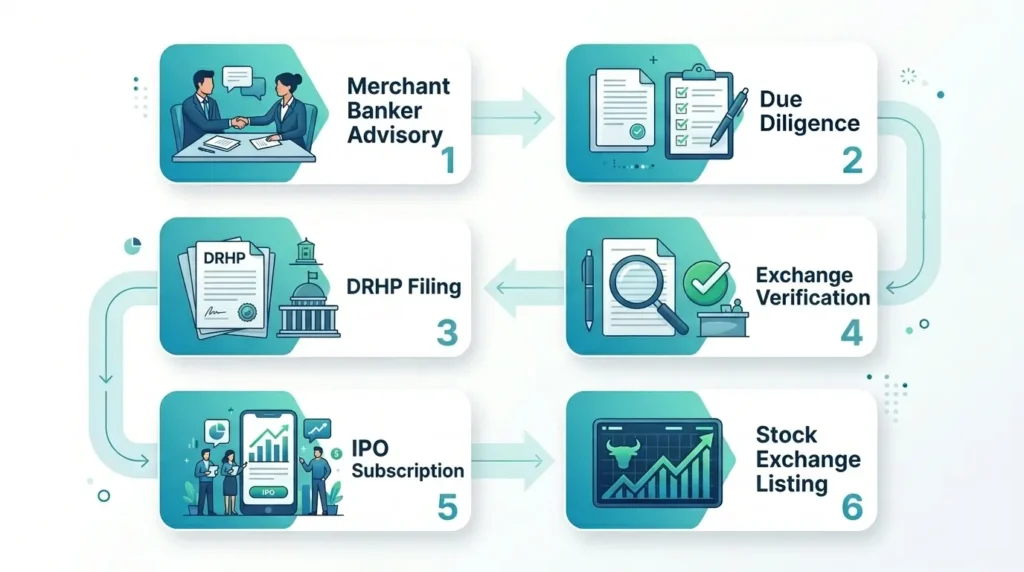
Here is how a company actually gets listed through an SME IPO, step by step:
1. Appoint a Merchant Banker (Lead Manager) The company appoints a SEBI-registered merchant banker who acts as the lead manager throughout the IPO process. The merchant banker is also responsible for market making after listing.
2. Due Diligence The merchant banker conducts detailed due diligence on the company’s financials, legal documents, material contracts, government approvals, and promoter background. This stage typically takes 2 to 3 months.
3. Prepare and File the Draft Red Herring Prospectus (DRHP) The DRHP is prepared and filed with the relevant exchange (BSE or NSE). It contains detailed information about the company, its promoters, financial history, objects of the issue (how money will be used), and risk factors.
4. Exchange Verification and Site Visit The exchange reviews the DRHP and sends an official to physically visit the company’s premises. Promoters are also interviewed by the Listing Advisory Committee.
5. In-Principle Approval If the exchange is satisfied, it grants in-principle approval for the IPO to proceed.
6. File the Red Herring Prospectus (RHP) with ROC The final RHP, which includes the opening and closing dates of the IPO, is filed with the Registrar of Companies (ROC) in the state where the company is incorporated.
7. Public Offering The IPO opens for subscription on the specified dates. Investors can apply during this window.
8. Allotment and Listing After the subscription window closes, allotment is processed by the registrar. Shares are credited to Demat accounts and the company gets listed on the exchange.
How to Evaluate an SME IPO Before Applying
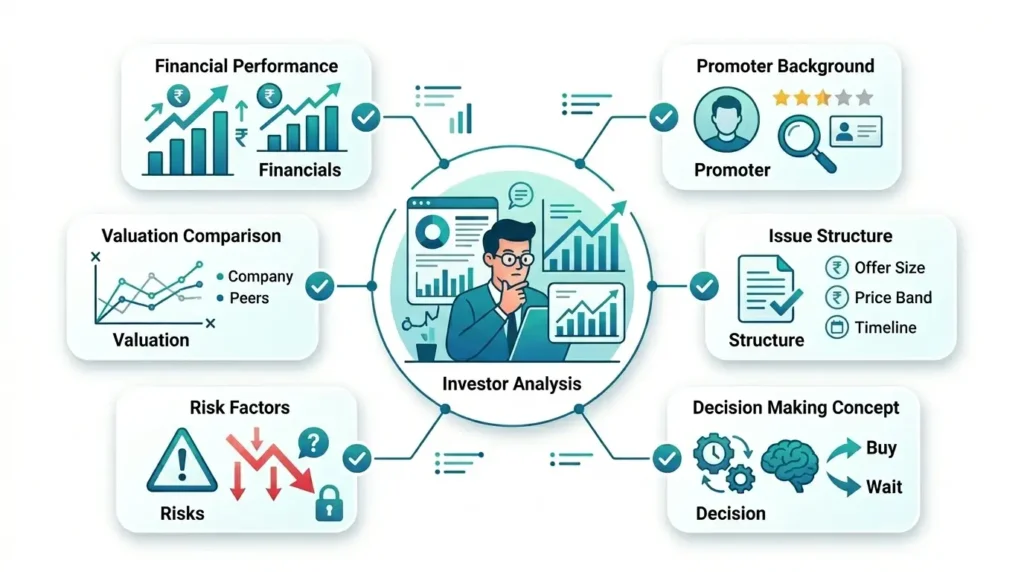
This section in the DRHP tells you exactly how the company plans to use the money raised. Common legitimate uses include capacity expansion, purchasing equipment, repaying debt, and working capital.
Red flags to watch for: A large portion going to “general corporate purposes” with no specifics. An unusually high amount going to repaying loans taken from promoters. Funds earmarked for acquisitions of businesses that have not been identified yet.
2. Check the Financial Track Record
Look at 3 years of audited financial statements in the DRHP. What you want to see: consistent revenue growth, improving or stable profit margins, and positive cash flows from operations.
What to be careful about: Revenue that jumped dramatically only in the year before the IPO. Profits that look good on paper but operating cash flows that are weak or negative. A sudden spike in debtors or inventory before the IPO.
3. Examine the Promoter Background
The DRHP includes a section on promoters with their qualifications, business history, and any legal proceedings. Check whether the promoters have relevant industry experience. Check whether they have run other businesses and, if so, how those businesses performed.
A promoter who has wound up multiple prior companies, or who has ongoing litigation with creditors or regulatory bodies, is a significant warning sign.
4. Compare Valuation Against Peers
The DRHP has a peer comparison table. Look at the Price-to-Earnings (P/E) ratio and Price-to-Book (P/B) ratio of the company at the IPO price versus listed peers in the same sector. An SME IPO asking for a P/E of 80x when mainboard peers trade at 25x is asking you to pay a massive premium for a less regulated, less liquid company. That needs a very strong reason to be justified.
5. Check the Issue Structure
Is this a fresh issue (company raises new money) or an offer for sale (existing shareholders sell)? An offer for sale means existing promoters or investors are cashing out. The company gets nothing from an OFS. A pure OFS in an SME IPO is a red flag because it means promoters want to exit before you invest.
6. Look at the Risk Factors Section
Every DRHP has a risk factors section. Most people ignore it. Read it. Companies are legally required to disclose material risks. If the company has customer concentration risk (one client accounts for 50% of revenue), regulatory risk, or pending litigation, it will be disclosed here. Judge whether the IPO price is fair given those risks.
Tax on SME IPO Gains: What You Need to Know
Many investors do not think about tax implications when applying for an SME IPO. Here is how SME IPO gains are taxed in India:
Short-Term Capital Gains (STCG)
If you sell your SME IPO shares within 12 months of the date of allotment (or listing date, which is typically 1 to 2 days after allotment), the gains are treated as Short-Term Capital Gains (STCG).
STCG on listed equity shares (which SME-listed stocks are, once they list) is taxed at 20% (as per the revised Budget 2024 rates effective July 23, 2024). Previously this was 15%.
Long-Term Capital Gains (LTCG)
If you hold your SME IPO shares for more than 12 months, the gains qualify as Long-Term Capital Gains (LTCG).
LTCG on listed equity shares above ₹1.25 lakh in a financial year is taxed at 12.5% without indexation benefit (revised rate effective July 23, 2024, up from earlier 10% above ₹1 lakh).
Tax on Listing Day Gains
If you sell your allotted shares on listing day itself (which is common for retail investors chasing the listing pop), the gains are short-term and taxed at 20% flat.
Securities Transaction Tax (STT)
On every sale of SME-listed shares through the exchange, STT at 0.1% is applicable. This is automatically deducted at the time of transaction
The Raw Picture: What Most Websites Do Not Tell You About SME IPOs
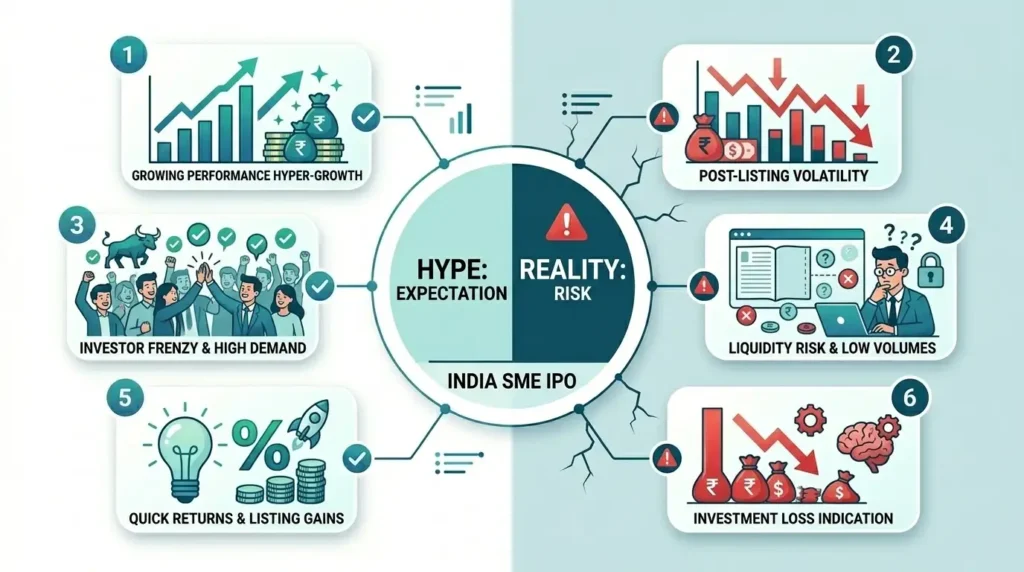
Most financial websites skip this part. Read it before you put in your first ₹1 lakh.
GMP is not research. It is often a setup. Grey Market Premium can be inflated by operators to manufacture the appearance of demand. Several SME stocks have crashed 30 to 50% within weeks of a strong GMP. It is unregulated and unverifiable. Use it as a rough sentiment check, nothing more.
Exiting after listing is harder than you think. SME shares trade in lots on the secondary market, not individual units. On many stocks, daily volumes run into a few thousand shares. Some days there are no trades at all. If you need to sell in a hurry, there may simply be no buyers.
SEBI does not directly vet these companies. The stock exchange reviews the DRHP, not SEBI. The scrutiny is structurally lighter, and SEBI has itself flagged price manipulation and dubious disclosures in SME-listed companies through multiple circulars.
Promoters can exit after just 1 year. Once the lock-in ends, even a small promoter sale in a thinly traded stock can drop the price sharply. Retail investors often find out only after the damage is done.
300x oversubscription does not mean 300x demand. Most applicants will not get allotted. The ones who do are often HNIs chasing the listing pop. Once they sell on day one, the price can fall hard if there is no genuine retail buying underneath.
That said, the SME platform has produced real, long-term winners across manufacturing, technology, and services. The problem is not the platform. It is that the lighter regulation puts the burden of filtering good from bad entirely on you as the investor.
Who Should Consider SME IPOs?
SME IPOs make more sense for investors who:
- Can afford to lock in ₹1 lakh or more per application without needing it back for at least 1 to 2 years
- Are willing to hold through low liquidity periods without panic-selling
- Have actually read the company’s DRHP and have a view on the business, not just the GMP
- Treat SME IPOs as a small percentage of their overall portfolio, not a primary strategy
- Have already gained experience with mainboard IPOs and understand how IPO investing works
- Understand that listing gains are not guaranteed and that post-listing crashes are common
If you are a new investor, the right order is: start with mutual funds, then move to mainboard stocks, then mainboard IPOs, and only then explore SME IPOs after you can read a balance sheet and a prospectus without getting lost.
SME IPO Migration to Mainboard
Once an SME-listed company grows and meets mainboard eligibility criteria, it can apply to migrate its listing from BSE SME or NSE Emerge to the main BSE or NSE board. This migration is a significant milestone because it brings the company under full SEBI oversight, requires quarterly results disclosures, and typically improves liquidity substantially.
For investors, a company that migrates to the mainboard after listing on the SME platform often sees a re-rating of its stock as institutional investors who could not buy it on the SME segment can now participate. Infollion Research, Ideaforge Technology, and Zaggle Prepaid Ocean Services are examples of companies that migrated or graduated from the SME segment to the mainboard.
Conclusion
SME IPOs are not a lottery. They are not a guaranteed shortcut to returns. They are investments in early-stage Indian businesses, which means the upside potential and the downside risk both sit higher than what you get on the mainboard.
The investors who do well in this segment are the ones who read the DRHP, understand what the company actually does, check the promoter background, look at 3 years of financials, and go in with the acceptance that they may need to hold for a year or two before the stock finds a fair price.
If you are just starting out, watch a few SME IPOs without putting money in. See how they list, how they trade one month later, and how they look one year on. That pattern, observed across 10 to 15 IPOs, will teach you more than any GMP chart or subscription data.
The SME platform has funded genuinely good Indian businesses. It has also been misused by companies looking for a quick exit and operators looking to profit from retail investors. The difference between the two is almost always visible in the prospectus. Take the time to read it.
FAQ's on SME IPO
SME stands for Small and Medium Enterprises.
SMEs are classified based on their investment in plant and machinery or equipment for manufacturing or service enterprises, respectively.
The categories are Micro Enterprises, Small Enterprises, and Medium Enterprises, each with specific investment thresholds.
SMEs contribute significantly to employment generation, industrial output, and overall economic growth in India.
SME IPO, or Small and Medium Enterprises Initial Public Offering, is the process through which smaller companies raise capital from the public by going public and listing their shares on a stock exchange.
Eligibility criteria may include post-issue paid-up capital, net tangible assets, an official website, facilitation of trading in dematerialized securities, and incorporation under the relevant Companies Act.
SME IPOs are listed on dedicated platforms called BSE SME (Bombay Stock Exchange SME) and NSE Emerge (National Stock Exchange Emerge).
Promoters are typically required to maintain their shareholdings unchanged for one year after the SME IPO.
Yes. Once a company meets mainboard eligibility criteria, it can apply to migrate from BSE SME or NSE Emerge to the main exchange. This migration typically improves liquidity and allows institutional investors to participate.
Gains from selling SME IPO shares within 12 months are taxed as Short-Term Capital Gains (STCG) at 20%. Gains from holding beyond 12 months are taxed as Long-Term Capital Gains (LTCG) at 12.5% above ₹1.25 lakh per financial year.
Promoters must hold their shares for at least 1 year after the IPO. This is shorter than mainboard IPO lock-in norms.

