
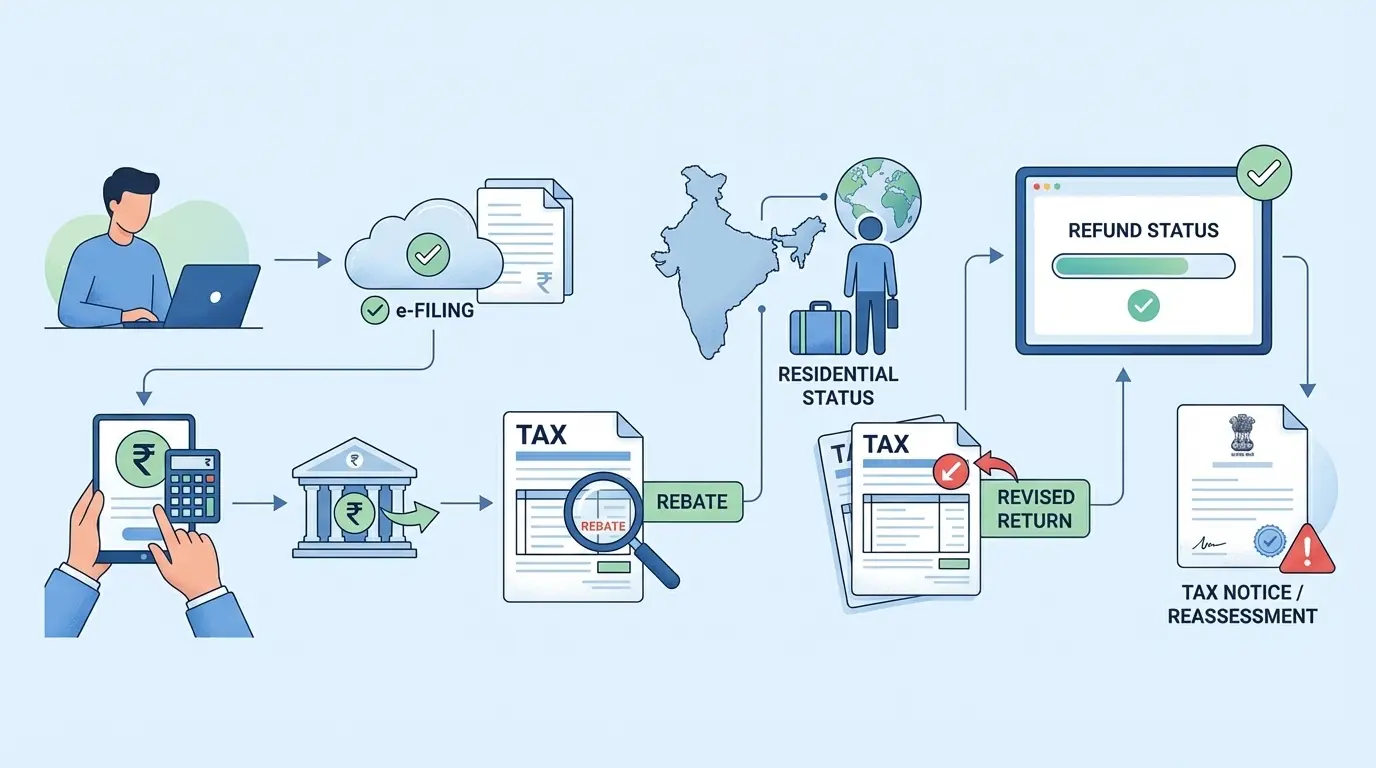
Income Tax Glossary R: Refund, Rebate, Return Explained
Several important taxation concepts begin with the letter R. This section of the income tax glossary explains key terms such as Refund, Rebate, Residential Status, Return Filing and Revised Return in simple language for Indian taxpayers.
Rebate (Section 87A)
Rebate under Section 87A is a tax benefit available to eligible individual taxpayers that reduces their total tax liability.
Explanation
If a taxpayer’s income falls within the specified limit, they can claim a rebate that directly reduces the amount of tax payable.
Key points:
- available only to resident individuals
- reduces final tax liability, not taxable income
- applicable under specific income thresholds
This benefit is especially useful for individuals in lower income brackets.
Refund (Income Tax Refund)
An income tax refund is the amount returned to a taxpayer when the tax paid exceeds the actual tax liability.
Explanation
Refunds may arise due to:
- excess TDS deducted
- higher advance tax paid
- eligible deductions reducing final tax liability
After filing the return, the Income Tax Department processes the return and credits the refund to the taxpayer’s bank account.
Residential Status
Residential status determines how an individual is taxed in India based on their physical presence in the country.
Explanation
Residential status is classified into:
- Resident
- Non-Resident
- Resident but Not Ordinarily Resident (RNOR)
It is determined based on the number of days an individual stays in India during a financial year.
Tax implications:
- residents are taxed on global income
- non-residents are taxed only on income earned in India
This is one of the most critical concepts in taxation.
Return Filing (ITR Filing)
Return filing refers to the process of submitting an income tax return to declare income, deductions, and taxes paid.
Explanation
Taxpayers must file returns if their income exceeds the prescribed limit or if required under specific conditions.
The return includes:
- income details
- deductions claimed
- taxes paid
- final tax payable or refund
Filing returns on time ensures compliance and avoids penalties.
Revised Return
A revised return is a corrected version of an already filed income tax return.
Explanation
If a taxpayer discovers an error or omission after filing the original return, they can file a revised return within the allowed time.
Corrections may include:
- missed income
- incorrect deductions
- wrong reporting
Filing a revised return helps avoid penalties and ensures accurate reporting.
Reassessment
Reassessment refers to the process where tax authorities reassess a taxpayer’s income if they believe income has escaped assessment.
Explanation
This may happen if:
- income was not reported
- incorrect details were provided
- new information becomes available
The tax department may issue a notice requiring the taxpayer to provide additional information.
Rectification
Rectification refers to the correction of errors apparent in an income tax return or assessment order.
Explanation
Taxpayers can request rectification if there are mistakes such as:
- calculation errors
- incorrect tax credit
- mismatch in records
Rectification is usually allowed for clear and obvious errors.
Refund Status
Refund status refers to the current stage of processing of an income tax refund.
Explanation
Taxpayers can track the status of their refund online.
Common statuses include:
- return processed
- refund approved
- refund issued
- refund failed
Tracking helps ensure timely receipt of refunds.
Return of Income
Return of income is the formal declaration of income submitted by a taxpayer to the tax authorities.
Explanation
It includes:
- total income earned
- deductions claimed
- taxes paid
This term is often used interchangeably with income tax return.
Regular Assessment
Regular assessment refers to the detailed examination of a taxpayer’s return by tax authorities.
Explanation
During this process, the tax department verifies:
- income declared
- deductions claimed
- supporting documents
If discrepancies are found, adjustments may be made to the tax liability.
Return Due Date
Return due date refers to the last date by which a taxpayer must file their income tax return for a financial year.
Explanation
The due date depends on the type of taxpayer such as:
- individuals
- businesses
- companies
Filing returns after the due date may result in:
- late filing fees
- interest charges
- loss of certain benefits like carry forward of losses
Timely filing ensures compliance and avoids penalties.
Return Processing (Section 143(1))
Return processing refers to the initial automated processing of an income tax return by the tax department.
Explanation
During processing, the system checks:
- arithmetic accuracy
- tax calculations
- TDS and tax credit details
After processing, an intimation is sent to the taxpayer showing:
- tax payable
- refund due
- or confirmation of no demand
Refund Adjustment
Refund adjustment refers to the process of adjusting a taxpayer’s refund against any outstanding tax demand.
Explanation
If a taxpayer has unpaid tax from previous years, the tax department may adjust the refund amount against that demand.
The remaining amount, if any, is credited to the taxpayer.
Reopening of Assessment
Reopening of assessment refers to the process where tax authorities reopen a previously completed assessment.
Explanation
This may happen if:
- income has escaped assessment
- new information becomes available
- discrepancies are identified later
The taxpayer may receive a notice and be required to provide additional details.
Remuneration (Tax Context)
Remuneration refers to payments made to employees or partners for services rendered.
Explanation
It includes:
- salary
- bonuses
- commissions
- partner remuneration
For taxation:
- employee remuneration is taxed as salary
- partner remuneration is taxed under business income rules
Rent Received
Rent received refers to income earned from letting out property.
Explanation
It is taxed under the head Income from House Property.
Tax calculation may include:
- deduction for municipal taxes
- standard deduction
- interest on housing loan
Reporting of Income
Reporting of income refers to the declaration of all income sources while filing an income tax return.
Explanation
Taxpayers must report income from:
- salary
- business or profession
- capital gains
- interest and other sources
Failure to report income accurately may lead to penalties and notices.
Resident but Not Ordinarily Resident (RNOR)
RNOR is a category of residential status under income tax law.
Explanation
An individual may qualify as RNOR if they meet specific conditions related to stay in India.
Tax treatment:
- income earned in India is taxable
- foreign income may not be taxable in certain cases
This status is important for individuals returning to India after staying abroad.


