
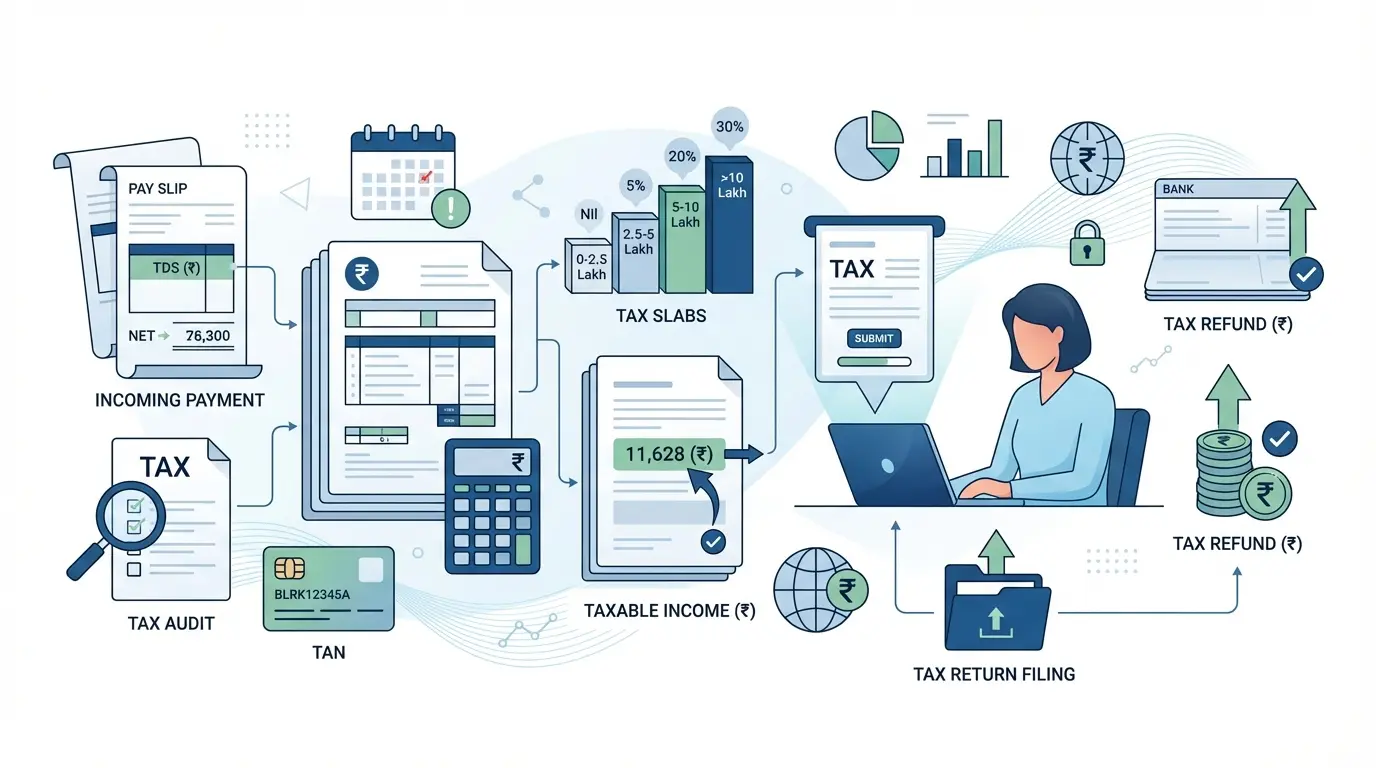
Income Tax Glossary T: TDS, Tax Liability, Tax Return Meaning
The letter T includes some of the most important income tax concepts used by taxpayers. This section of the income tax glossary explains terms such as TDS, Taxable Income, Tax Liability, Tax Return and Tax Audit in simple language.
Tax
Salary refers to the income received by an employee from an employer under an employment contract.
Explanation
Salary is one of the most common sources of income and is taxed under the head Income from Salary.
It may include:
- basic salary
- allowances
- bonuses
- perquisites
- employer contributions
Salary income is subject to tax after applicable deductions.
Taxable Income
Taxable income is the portion of total income on which income tax is calculated.
Explanation
It is computed after:
- adding income from all sources
- subtracting eligible deductions and exemptions
Taxable income determines the final tax liability based on applicable slab rates.
Tax Liability
Tax liability refers to the total amount of tax a taxpayer is required to pay.
Explanation
It is calculated after considering:
- taxable income
- tax rates
- deductions
- taxes already paid
If tax paid is less than liability, the remaining amount must be paid.
Tax Deducted at Source (TDS)
Tax Deducted at Source (TDS) is a system where tax is deducted at the time of making certain payments.
Explanation
The payer deducts tax before making payment and deposits it with the Income Tax Department.
Common TDS deductions apply to:
- salary
- interest income
- rent
- professional fees
This ensures timely collection of tax.
Tax Collected at Source (TCS)
Tax Collected at Source (TCS) is a system where the seller collects tax from the buyer at the time of sale.
Explanation
The collected tax is deposited with the government.
TCS applies to certain goods and transactions such as:
- sale of specific goods
- foreign remittances
- high-value purchases
Tax Audit
Tax audit is the examination of a taxpayer’s financial records to ensure compliance with tax laws.
Explanation
It is required when turnover or receipts exceed specified limits.
A tax audit is conducted by a chartered accountant and helps ensure:
- accurate reporting of income
- proper maintenance of records
- compliance with tax rules
Tax Planning
Tax planning refers to arranging financial affairs in a way that minimizes tax liability within legal limits.
Explanation
It involves:
- using deductions and exemptions
- choosing tax-efficient investments
- selecting the appropriate tax regime
Proper tax planning helps reduce the overall tax burden.
Tax Evasion
Tax evasion refers to the illegal practice of not paying taxes by concealing income or providing false information.
Explanation
Examples include:
- hiding income
- falsifying expenses
- not reporting transactions
Tax evasion can result in penalties and legal action.
Tax Avoidance
Tax avoidance refers to the legal use of tax laws to reduce tax liability.
Explanation
Unlike tax evasion, tax avoidance is legal but may involve aggressive use of loopholes in tax laws.
Tax planning is a legitimate form of tax avoidance.
Tax Refund
A tax refund is the amount returned to a taxpayer when excess tax has been paid.
Explanation
Refunds arise when:
- excess TDS is deducted
- advance tax paid is higher
- deductions reduce final tax liability
Refunds are processed after filing returns.
Tax Deduction
Tax deduction refers to amounts that can be subtracted from total income to reduce taxable income.
Explanation
Common deductions include:
- investments under Section 80C
- health insurance premiums
- education loan interest
Deductions help reduce tax liability.
Tax Credit
Tax credit refers to the amount of tax already paid that can be adjusted against total tax liability.
Explanation
Examples include:
- TDS
- advance tax
- self-assessment tax
Tax credit reduces the final amount payable.
Tax Slab
Tax slab refers to the range of income taxed at a specific rate.
Explanation
Income tax is calculated based on slabs where higher income is taxed at higher rates.
Different slabs apply under:
- old tax regime
- new tax regime
Tax Return
Tax return refers to the form filed by taxpayers to declare income and taxes paid.
Explanation
It includes:
- income details
- deductions
- taxes paid
It is used to calculate tax payable or refund.
Tax Year (Financial Year)
Tax year refers to the period for which income is calculated for tax purposes.
Explanation
In India, the tax year is:
- 1 April to 31 March
Income earned during this period is taxed in the following assessment year.
Turnover
Turnover refers to the total revenue generated by a business during a financial year.
Explanation
It is used to determine:
- tax audit applicability
- eligibility for presumptive taxation
- business performance
Transfer Pricing
Transfer pricing refers to pricing of transactions between related entities.
Explanation
It is relevant for multinational companies and ensures that transactions are conducted at fair market value.
This prevents profit shifting and tax avoidance.
Tax Deduction at Source Certificate (TDS Certificate)
A TDS certificate is a document issued by the deductor showing the amount of tax deducted and deposited on behalf of the taxpayer.
Explanation
Common forms include:
- Form 16 (for salary)
- Form 16A (for non-salary payments)
These certificates help taxpayers:
- verify TDS deducted
- claim tax credit while filing returns
Tax Collected at Source Certificate (TCS Certificate)
A TCS certificate is issued by the seller to the buyer showing the tax collected at source.
Explanation
It confirms that TCS has been collected and deposited with the government.
It is used to claim credit for TCS while filing returns.
Tax Payment Challan
A tax payment challan is a document used to pay taxes to the government.
Explanation
It is used for:
- advance tax
- self-assessment tax
- regular tax payments
After payment, a challan receipt is generated as proof of payment.
Tax Demand
Tax demand refers to the amount of tax that the tax department claims is payable by the taxpayer.
Explanation
It may arise due to:
- mismatch in income
- incorrect tax calculation
- reassessment
Taxpayers can either:
- pay the demand
- dispute it
- request rectification
Tax Residency Certificate (TRC)
A Tax Residency Certificate is a document that certifies the country of residence of a taxpayer for tax purposes.
Explanation
It is mainly used in international taxation to:
- claim benefits under Double Taxation Avoidance Agreements (DTAA)
- avoid double taxation
Tax Holiday
Tax holiday refers to a period during which a taxpayer or business is exempt from paying certain taxes.
Explanation
It is often granted to:
- startups
- specific industries
- businesses in special zones
It encourages investment and economic growth.
Tax Invoice
A tax invoice is a document issued by a seller showing details of goods or services and applicable taxes.
Explanation
Although more relevant under GST, it is important for:
- business accounting
- expense tracking
- tax compliance
Tax Arrears
Tax arrears refer to unpaid taxes from previous periods.
Explanation
They may arise due to:
- non-payment
- disputes
- reassessment
Arrears may attract interest and penalties if not cleared.
Tax Compliance
Tax compliance refers to adhering to all tax laws and regulations.
Explanation
It includes:
- filing returns on time
- paying taxes correctly
- maintaining records
- responding to notices
Proper compliance avoids penalties and legal issues.
Taxable Event
A taxable event is an occurrence that triggers a tax liability.
Explanation
Examples include:
- earning income
- selling an asset
- receiving interest
Once a taxable event occurs, tax becomes applicable.
