
Income Tax Glossary S: Salary, 80C, STCG Explained
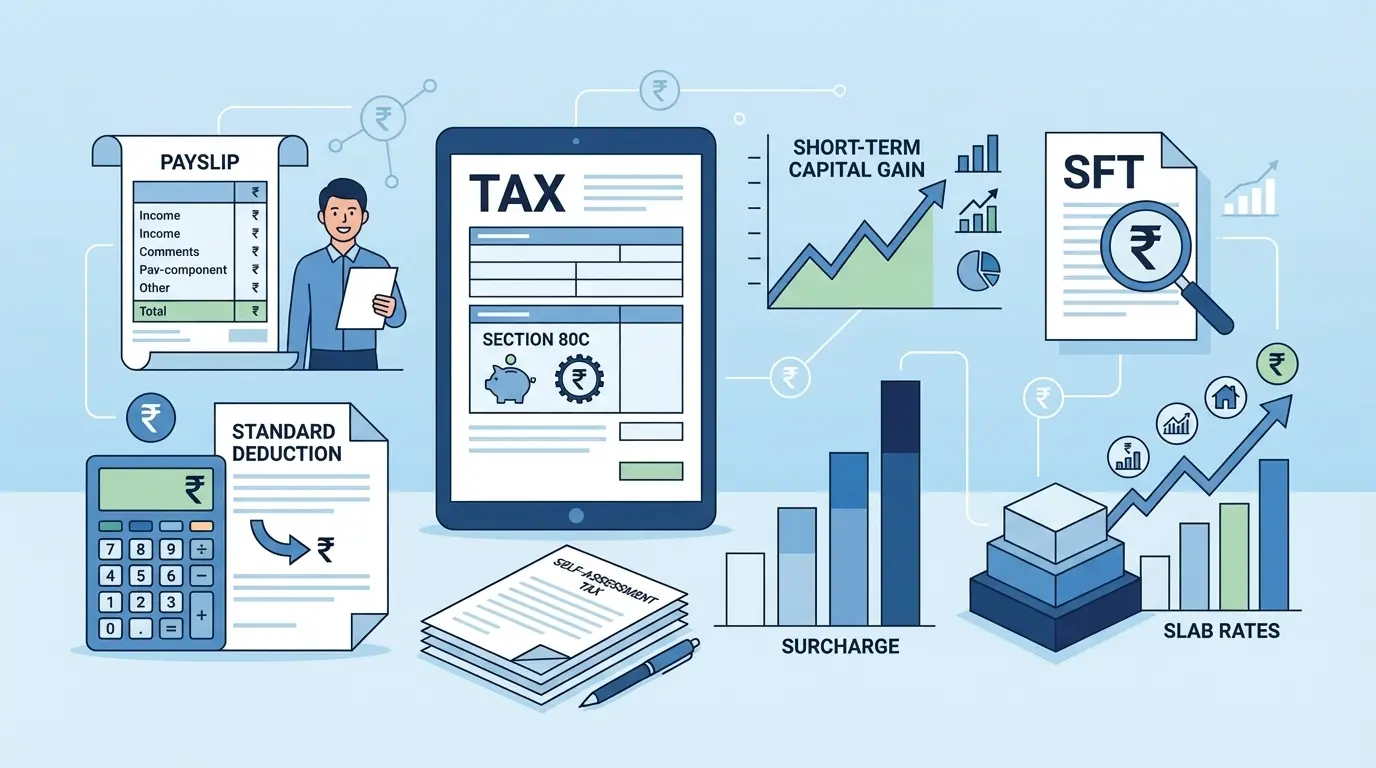
The letter S includes some of the most important income tax concepts used by taxpayers. This section of the income tax glossary explains terms such as Salary, Standard Deduction, Section 80C, Surcharge and Short-Term Capital Gains in simple language.
Salary
Salary refers to the income received by an employee from an employer under an employment contract.
Explanation
Salary is one of the most common sources of income and is taxed under the head Income from Salary.
It may include:
- basic salary
- allowances
- bonuses
- perquisites
- employer contributions
Salary income is subject to tax after applicable deductions.
Standard Deduction
Standard deduction is a fixed deduction allowed from salary income without requiring any proof of expenses.
Explanation
It reduces taxable salary income and simplifies tax calculation.
This deduction is available to:
- salaried individuals
- pensioners
It helps lower overall tax liability.
Section 80C
Section 80C is a provision under income tax law that allows deductions for specified investments and expenses.
Explanation
Taxpayers can reduce their taxable income by investing in eligible instruments.
Common investments include:
- life insurance premiums
- provident fund contributions
- ELSS mutual funds
- tuition fees
- principal repayment of home loan
This is one of the most widely used tax-saving sections.
Section 80D
Section 80D allows deductions for health insurance premiums paid.
Explanation
Taxpayers can claim deductions for:
- self and family
- parents
This promotes financial protection against medical expenses.
Section 80E
Section 80E allows deduction on interest paid on education loans.
Explanation
This deduction is available for loans taken for higher education.
Only interest (not principal) is eligible for deduction.
Section 80G
Section 80G allows deductions for donations made to specified charitable institutions.
Explanation
The deduction depends on:
- type of institution
- percentage allowed
Donations must be made to approved entities.
Section 80TTA
Section 80TTA allows deduction on interest earned from savings accounts.
Explanation
This deduction is available to individual taxpayers and helps reduce tax on interest income.
Section 80TTB
Section 80TTB allows higher deduction on interest income for senior citizens.
Explanation
It covers interest from:
- savings accounts
- fixed deposits
- recurring deposits
This provides additional benefit to senior citizens.
Section 80EE / 80EEA
These sections allow deductions on interest paid on home loans subject to certain conditions.
Explanation
They are designed to promote home ownership by providing additional tax benefits on housing loans.
Section 80CCD
Section 80CCD allows deductions for contributions made to pension schemes such as the National Pension System (NPS).
Explanation
This deduction is available for:
- employee contributions
- employer contributions
It is an important tax-saving option for retirement planning.
Section 10 (Exempt Income)
Section 10 lists incomes that are exempt from tax under income tax law.
Explanation
Examples include:
- certain allowances
- agricultural income
- specified benefits
These incomes are not included in taxable income.
Section 44AD
Section 44AD is a presumptive taxation scheme for small businesses.
Explanation
It allows taxpayers to declare income as a fixed percentage of turnover without maintaining detailed books.
Section 44ADA
Section 44ADA is a presumptive taxation scheme for professionals.
Explanation
Professionals can declare income as a percentage of receipts, simplifying tax compliance.
Section 44AB (Tax Audit)
Section 44AB relates to tax audit requirements for businesses and professionals.
Explanation
If turnover exceeds specified limits, a tax audit must be conducted by a chartered accountant.
Section 139(1)
Section 139(1) deals with the mandatory filing of income tax returns.
Explanation
It specifies who must file returns and the applicable due dates.
Section 139(5)
Section 139(5) allows taxpayers to file a revised return.
Explanation
It enables correction of errors in the original return.
Section 139(9)
Section 139(9) deals with defective returns.
Explanation
If a return is incomplete or incorrect, it may be treated as defective and must be corrected within a specified time.
Section 234A / 234B / 234C
These sections deal with interest charged for delays or defaults in tax payments.
Explanation
They cover:
- delay in filing return
- shortfall in advance tax
- delay in advance tax installments
Surcharge
Surcharge is an additional tax levied on taxpayers whose income exceeds specified limits.
Explanation
It is calculated as a percentage of the income tax payable.
Higher income levels attract higher surcharge rates.
Self-Assessment Tax
Self-assessment tax is the tax paid by a taxpayer after calculating their total income and tax liability.
Explanation
It is paid before filing the income tax return if there is any tax remaining after:
- TDS
- advance tax
This ensures full tax payment before filing.
Short-Term Capital Gain (STCG)
Short-Term Capital Gain refers to profit earned from selling an asset within a short holding period.
Explanation
The holding period depends on the type of asset.
STCG is usually taxed at higher rates compared to long-term capital gains.
Short-Term Capital Loss (STCL)
Short-Term Capital Loss occurs when a short-term asset is sold at a loss.
Explanation
This loss can be adjusted against:
- short-term capital gains
- long-term capital gains
Unadjusted losses can be carried forward.
Securities Transaction Tax (STT)
Securities Transaction Tax is a tax levied on the purchase and sale of securities traded on stock exchanges.
Explanation
It is automatically deducted during transactions involving:
- shares
- derivatives
- equity mutual funds
STT plays a role in capital gains taxation.
Specified Financial Transaction (SFT)
Specified Financial Transaction refers to certain high-value financial transactions that must be reported to tax authorities.
Explanation
Examples include:
- large cash deposits
- property transactions
- high-value investments
These transactions help authorities track tax compliance.
Set-Off of Losses
Set-off of losses refers to adjusting losses against income to reduce taxable income.
Explanation
Losses can be adjusted:
- within the same head of income
- across different heads (subject to rules)
This helps reduce tax liability.
Senior Citizen
A senior citizen is an individual above a specified age who receives special tax benefits.
Explanation
Benefits may include:
- higher exemption limits
- additional deductions
- lower compliance requirements
Slab Rate
Slab rate refers to the tax rates applied to different income ranges.
Explanation
Income tax is calculated based on slabs, where higher income is taxed at higher rates.
Different slabs apply under:
- old tax regime
- new tax regime
Salary Slip
A salary slip is a document provided by an employer showing salary details.
Explanation
It includes:
- salary components
- deductions
- tax deducted
It is important for filing income tax returns.
Super Senior Citizen
A super senior citizen is an individual above a higher age threshold eligible for additional tax benefits.
Explanation
They may receive:
- higher exemption limits
- additional reliefs
Speculation Income
Speculation income refers to income earned from speculative transactions such as intraday trading.
Explanation
This income is taxed differently and has specific rules for loss set-off.
Salary Income Components
Salary income components refer to different parts that make up total salary.
Explanation
These include:
- basic salary
- HRA
- allowances
- bonuses
- perquisites
Understanding components helps in tax planning.
Statement of Financial Transactions (SFT)
SFT is a report of high-value transactions submitted to tax authorities by financial institutions.
Explanation
It helps track large financial activities and detect tax evasion.
Stamp Duty Value
Stamp duty value refers to the value of property as determined by government authorities for stamp duty purposes.
Explanation
It is used in taxation for:
- property transactions
- capital gains calculation
Secured Loan (Tax Context)
A secured loan is a loan backed by collateral such as property or assets.
Explanation
Interest paid on certain secured loans may qualify for tax deductions depending on usage.
