
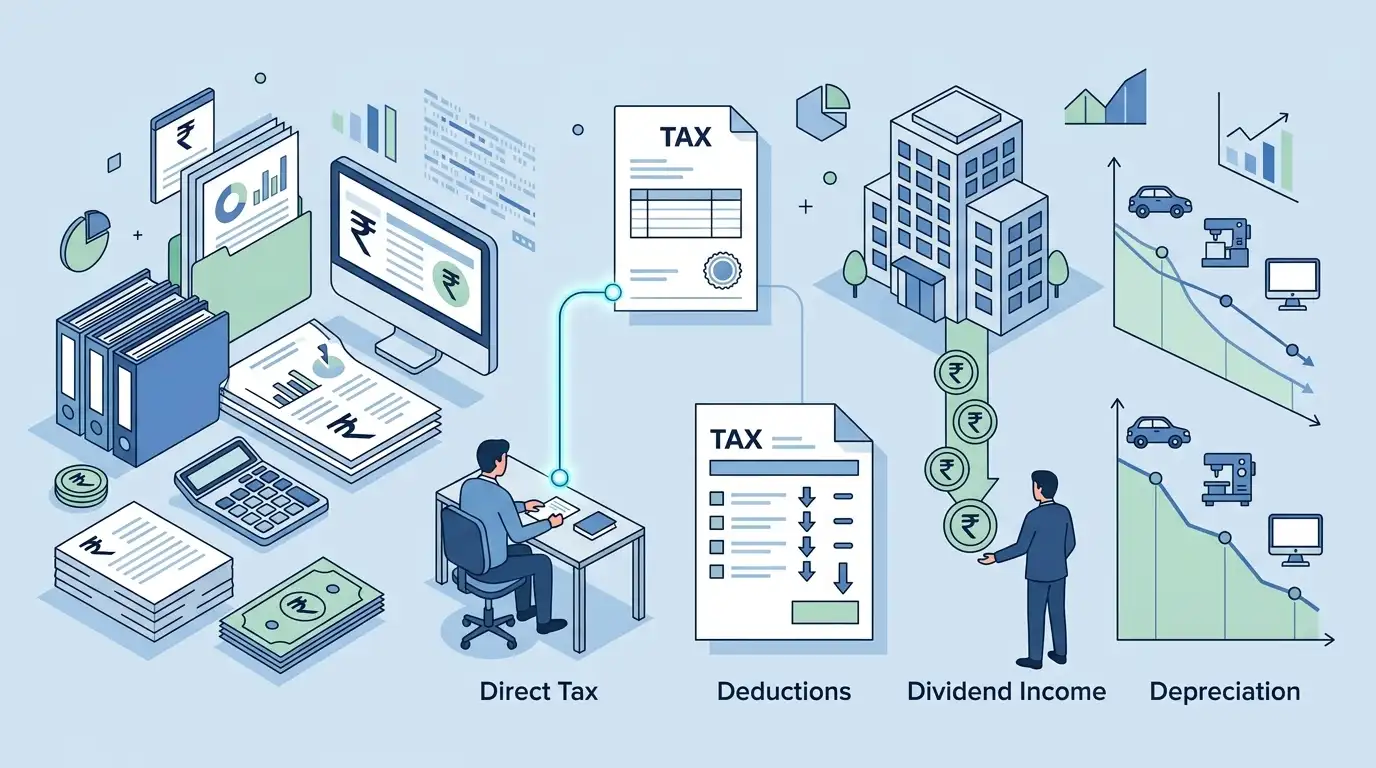
Income Tax Glossary D: Deduction, Depreciation, Dividend
Several important taxation concepts begin with the letter D. This section of the income tax glossary explains commonly used terms such as Deduction, Depreciation, Dividend, Direct Tax, and Double Taxation in simple language for Indian taxpayers.
Deduction
A deduction is an amount that can be subtracted from a taxpayer’s gross total income to reduce taxable income.
Explanation
Tax deductions are allowed under various provisions of the income tax law to encourage savings, investments, and certain types of spending.
By claiming deductions, taxpayers can legally reduce the amount of income on which tax is calculated.
Common deductions are related to:
• investments in specified financial instruments
• health insurance premiums
• contributions to retirement schemes
• donations to charitable institutions
Deductions are mainly available under the old tax regime, while the new tax regime allows fewer deductions.
Example
If a person earns ₹10 lakh and claims ₹1.5 lakh as deductions, the taxable income becomes ₹8.5 lakh.
Depreciation
Depreciation refers to the reduction in the value of an asset over time due to wear and tear, usage, or technological obsolescence.
Explanation
In business taxation, depreciation is allowed as an expense when calculating taxable profits. This recognizes that assets such as machinery, vehicles, and computers lose value as they are used.
Instead of deducting the entire cost of the asset in one year, the cost is spread over several years through depreciation.
Example
If a business purchases machinery worth ₹5 lakh, it may claim depreciation each year to account for the gradual reduction in the asset’s value.
Dividend
A dividend is a portion of a company’s profits that is distributed to its shareholders.
Explanation
Companies may choose to distribute part of their profits to investors in the form of dividends. These payments represent a return on investment for shareholders.
Dividends can be paid:
• annually
• semi-annually
• quarterly
Dividend income is generally taxable in the hands of the investor according to the applicable tax rules.
Example
If an investor owns shares of a company and receives ₹10,000 as dividend during the year, that amount is considered dividend income.
Direct Tax
Direct tax is a tax that is paid directly by the person or entity on whom the tax is imposed.
Explanation
Direct taxes cannot be shifted to another person. The taxpayer who earns the income is responsible for paying the tax.
Income tax is one of the most common examples of direct tax.
Other types of direct taxes may apply to companies or businesses depending on the tax laws.
Double Taxation
Double taxation occurs when the same income is taxed more than once.
Explanation
This situation can arise in different scenarios, particularly when income is taxed in two different countries or when corporate profits are taxed at both the company and shareholder levels.
To prevent unfair taxation, many countries enter into agreements known as Double Taxation Avoidance Agreements (DTAAs).
These agreements ensure that income is not taxed twice in two different jurisdictions.
Double Taxation Avoidance Agreement (DTAA)
A Double Taxation Avoidance Agreement is a treaty between two countries that aims to prevent the same income from being taxed in both countries.
Explanation
Such agreements determine which country has the right to tax certain types of income such as:
- salaries
- business income
- interest
- dividends
- capital gains
DTAAs help taxpayers avoid paying tax twice on the same income.
Deemed Income
Deemed income refers to income that may not have been actually received but is treated as taxable income under certain provisions of tax law.
Explanation
Tax laws sometimes classify specific receipts or transactions as income even if they do not appear to be conventional earnings.
These rules are designed to prevent tax avoidance and ensure that certain financial benefits are properly taxed.
Deemed Dividend
Deemed dividend refers to certain payments made by a company to its shareholders that are treated as dividends for tax purposes even if they are not formally declared as dividends.
Explanation
This rule typically applies when closely held companies provide loans or advances to shareholders in situations that effectively distribute company profits.
Such payments may be treated as dividend income and taxed accordingly.
Demand Notice
A demand notice is an official communication issued by the tax department requesting payment of tax dues.
Explanation
If the tax department determines that a taxpayer owes additional tax after assessment or review, it may issue a demand notice specifying:
- the amount payable
- the reason for the demand
- the deadline for payment
Taxpayers must respond to such notices within the prescribed time.
Disallowance
Disallowance refers to the rejection of a deduction or expense claimed by a taxpayer during tax assessment.
Explanation
If the tax authorities determine that an expense claimed by a taxpayer does not meet the conditions specified under tax law, the expense may be disallowed.
This increases the taxable income and the final tax liability.
