
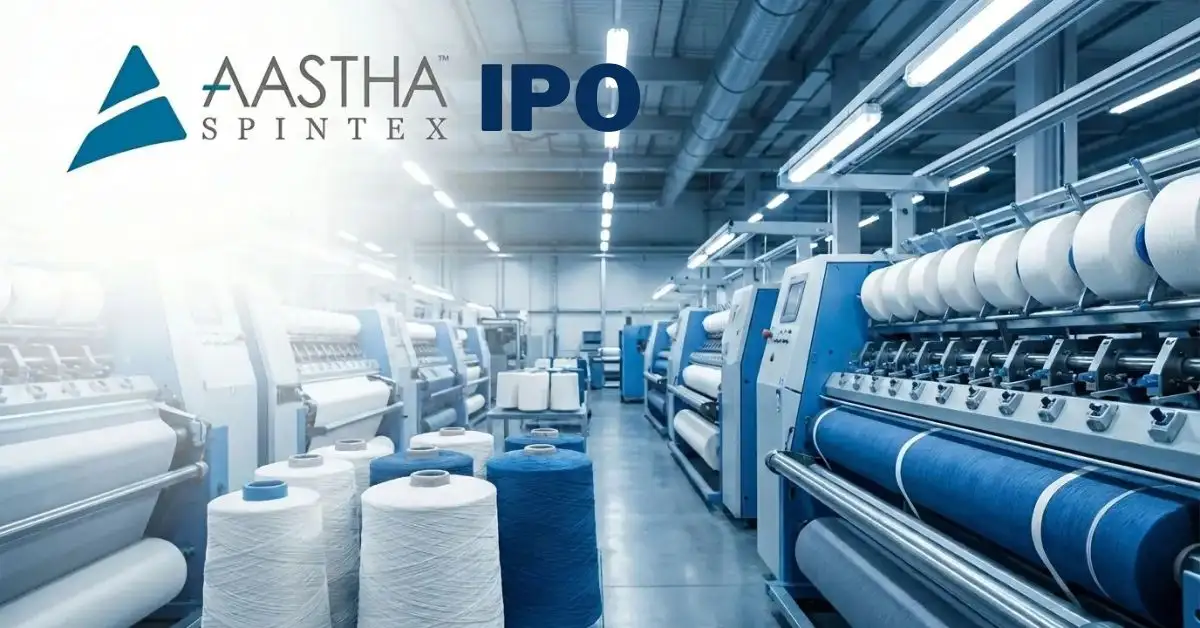
Aastha Spintex IPO Date, Price, GMP, Review, Details

Aastha Spintex Limited

Aastha Spintex IPO Details
IPO Open
TBD
IPO Close
TBD
Price Band
TBD
Issue Size
TBD
Listing on
BSE, NSE
Min. Lot Size
TBD
Face value
TBD
GMP
N/A
Key Performance Indicators
Market Cap
TBD
P/E
TBD
EPS
TBD
ROE
23.73%
ROCE
19.12%
Sector
Sector
Aastha Spintex IPO Timeline
To be announced
Introduction
Aastha Spintex Limited is a textile manufacturing company engaged in the production of cotton yarn. The company operates a modern spinning facility in Gujarat and caters to both domestic and export markets. Its focus is on consistent quality, cost efficiency, and large-scale production.
The Indian textile and yarn industry plays a critical role in the country’s manufacturing and export ecosystem. Rising demand from apparel manufacturers, export orders, and government support for the textile sector continue to drive growth. Cotton yarn remains a key raw material for fabric and garment producers.
Aastha Spintex benefits from integrated operations, experienced promoters, and a strategically located manufacturing unit. The IPO aims to strengthen the company’s financial position and support future growth plans. For investors, this IPO provides exposure to a core manufacturing business with linkage to domestic consumption and exports.
About Aastha Spintex
Aastha Spintex Limited was founded by Patel Divyang Jashwantbhai, Rasiklal Valjibhai Patel, Gothi Vivek Rasiklal, and Jashwantbhai Valjibhai Patel. The company was incorporated in 2013 in Gujarat. It began as a private limited entity focused on cotton yarn manufacturing. Over the years, the company expanded its spinning capacity and operational scale. In 2025, the company was converted into a public limited company as part of its IPO journey. Key milestones include capacity expansion, export market entry, and financial scale-up.
Business Model
Aastha Spintex operates on a manufacturing-led cotton yarn production model. The company procures raw cotton, processes it through in-house spinning facilities, and supplies finished yarn to textile manufacturers. Operations are largely asset-heavy and volume-driven, allowing cost efficiency. Sales are handled through direct relationships with customers and trade intermediaries. The business follows a pure-play manufacturing model with no retail presence.
Brand and Market Positioning
The company is positioned as a reliable cotton yarn supplier in the mid-sized textile segment. Customers value consistent quality, timely delivery, and pricing stability. While it does not operate as a premium brand, it maintains credibility among fabric and garment manufacturers. Competitive pricing and operational discipline provide steady customer retention rather than aggressive branding.
Products and Services
Cotton yarn
Combed cotton yarn
Carded cotton yarn
Textile-grade yarn for weaving
Yarn for export-oriented manufacturers
Flagship Offerings
The company’s flagship offering is cotton yarn used in fabric and garment manufacturing. This product forms the backbone of revenue. Entry barriers arise from capital-intensive machinery, working capital needs, and operational expertise. Scale and location advantage create moderate competitive protection, though the industry remains fragmented.
Revenue Profile
Revenue is primarily generated from cotton yarn sales. Domestic sales contribute a major portion, supported by export orders. Clients include textile mills, fabric producers, and garment manufacturers. The cotton yarn segment contributes the highest share of revenue. Export exposure adds diversification but also currency sensitivity.
Geographical Footprint
Manufacturing operations are based in Gujarat, a major textile hub in India. The company operates a single large manufacturing facility. Sales are spread across multiple Indian states. Export sales cater to select overseas markets through trade channels. Gujarat remains the core operational and logistical base.
Management and Promoters
The company is led by Patel Divyang Jashwantbhai, who serves as Chairman and Managing Director. Other promoters actively participate in operations and strategic decisions. The management team includes professionals handling finance, compliance, and production. Governance is supported by board committees aligned with regulatory norms. Promoter-led management plays a central role in execution.
Corporate Structure
Aastha Spintex Limited operates as a standalone entity. There are no major subsidiaries or joint ventures disclosed as of now. Business operations are consolidated under one corporate structure. This simplifies financial reporting and operational control.
Target Customers
The business primarily follows a B2B model. Target customers include textile mills, fabric manufacturers, and garment exporters. Customers are price-sensitive and volume-focused. Long-term relationships matter more than branding. Industrial textile buyers form the core customer base.
How the Company Earns
The company earns through one-time sales of manufactured yarn. Revenue is generated per order based on volume and yarn specifications. There is no subscription or service-based income. Product sales remain the primary earning channel.
Market Position
Aastha Spintex operates in a highly competitive and fragmented textile yarn industry. It does not claim top-tier dominance but holds a stable position among regional players. The company benefits from location, scale, and operational continuity. It is positioned as a steady mid-sized manufacturer rather than a market leader.
About Aastha Spintex IPO
Aastha Spintex IPO is a ₹160 crore public issue consisting entirely of a fresh issue of equity shares. There is no Offer for Sale (OFS) component in this IPO. The issue is being managed by BOI Merchant Bankers Limited and PNB Investment Services Limited as the Book Running Lead Managers. The Registrar to the Issue is Bigshare Services Private Limited. The IPO is aimed at raising growth capital for the company.
Aastha Spintex IPO will be offered through a 100% book-built process. The price band, lot size, and minimum investment amount will be announced closer to the issue opening. The equity shares have a face value of ₹10 per share. The shares are proposed to be listed on BSE and NSE, providing liquidity and wider investor access.
The proceeds from the fresh issue will be used to strengthen the company’s balance sheet. Key objectives include funding working capital requirements, supporting operational expansion, and meeting general corporate purposes. The capital infusion is expected to improve financial flexibility and support future growth initiatives in the textile manufacturing business.
The anchor investor bidding date, IPO opening date, and closing date will be announced after the filing of the Red Herring Prospectus. The allotment, refunds, demat credit, and listing are expected to follow the standard SEBI IPO timeline, with listing likely within 5–6 working days from issue closure.
Aastha Spintex IPO Details
Issue Type: 100% Book-Built Issue
Total Issue Size: ₹160 crore
Fresh Issue: ₹160 crore
OFS: Nil
Price Band: To be announced
Face Value: ₹10 per share
Lot Size: To be announced
Minimum Retail Investment: To be announced
Listing: BSE, NSE
Pre-IPO Placement: Not applicable
Employee Reservation: Not applicable
BRLMs:
BOI Merchant Bankers Limited
PNB Investment Services Limited
Registrar:
Bigshare Services Private Limited
IPO Timeline
Anchor Date: To be announced
Issue Opens: To be announced
Issue Closes: To be announced
Allotment Finalisation: To be announced
Refunds: To be announced
Demat Credit: To be announced
Listing Date: To be announced
Valuation Snapshot
Price Band: To be announced
Implied Market Cap: To be announced
P/E: To be announced
EV/EBITDA: To be announced
Price-to-Sales: To be announced
Pre-IPO Placement Price: Not applicable
Valuation Justification
The valuation of Aastha Spintex will depend on the final price band and market conditions at the time of the IPO. As a manufacturing-led textile company, valuation will be benchmarked against peer yarn manufacturers on earnings, asset base, and return ratios. Investors should evaluate pricing in relation to growth visibility, margin stability, and industry cyclicality once the price band is disclosed.
Industry Overview
The textile industry is one of India’s most important manufacturing sectors and a major contributor to employment, exports, and industrial output. It covers the entire value chain starting from raw fibre to yarn, fabric, garments, and finished textile products. Cotton yarn spinning is a core upstream activity that supplies essential input to weaving, knitting, and garment manufacturing units.
Market Size and Segmentation
India is one of the largest producers of cotton and cotton yarn globally. The textile sector contributes significantly to India’s manufacturing GDP and export earnings. The industry is broadly segmented into spinning, weaving, processing, and garmenting. Among these, the spinning segment forms the backbone of the textile ecosystem by converting raw cotton into yarn used across multiple end-use industries.
Key Drivers and Industry Lifecycle
Growth in the yarn spinning industry is driven by domestic apparel consumption, export demand, availability of raw cotton, and government support for manufacturing. Rising urbanisation, population growth, and changing fashion trends support long-term demand. The spinning industry is mature but continues to grow through capacity expansion, modernisation of machinery, and efficiency improvements.
Demand Dynamics
Demand for cotton yarn primarily comes from fabric manufacturers, garment exporters, home textile producers, and knitting units. Domestic demand is relatively stable due to everyday clothing requirements, while export demand depends on global apparel cycles. Seasonal trends, cotton crop quality, and international yarn prices influence short-term demand patterns.
Competitive Landscape (Porter’s Five Forces)
The spinning industry is highly fragmented with a large number of small, medium, and large players. Entry barriers are moderate due to high capital investment and working capital needs. Buyer bargaining power is high as customers are price-sensitive and have multiple sourcing options. Supplier power varies depending on cotton availability and crop conditions. Substitution risk exists from synthetic yarns, especially during periods of high cotton prices.
Operational Benchmarks
Key operational metrics in the spinning industry include spindle capacity utilisation, yarn realisation per kilogram, operating margins, energy consumption, labour productivity, and working capital cycles. Efficient players focus on scale, automation, energy efficiency, and procurement optimisation to protect margins in a competitive environment.
Regulatory and ESG Environment
The textile industry is subject to labour regulations, environmental compliance, pollution control norms, and export regulations. ESG considerations are becoming increasingly important, especially for export-focused companies. Water usage, power consumption, waste disposal, and worker safety are key compliance areas that influence long-term sustainability.
Geopolitical and Supply Chain Risks
Global trade policies, import-export duties, and geopolitical tensions can impact textile exports. Currency fluctuations affect export realisations and raw material costs. Disruptions in cotton supply due to weather conditions or logistics issues can impact production schedules and profitability.
Future Outlook and Major Risks
The long-term outlook for the cotton yarn industry remains stable, supported by steady domestic consumption and export demand. However, risks include raw material price volatility, margin pressure, global economic slowdown, competition from low-cost countries, and rising compliance costs.
Conclusion and Investment Context
The cotton yarn spinning industry offers predictable demand but operates on thin margins. Companies with efficient operations, scale advantages, disciplined cost control, and strong balance sheets are better positioned to sustain profitability. Investors should evaluate companies based on operational efficiency, financial strength, and ability to manage industry cycles.
Peer Analysis
Revenue Scale
Aastha Spintex – Mid-sized yarn manufacturer
Vardhman Textiles – ₹10,000+ crore
KPR Mill – ₹6,000+ crore
Trident – ₹6,500+ crore
Nitin Spinners – ₹3,000+ crore
Profitability (PAT Margin)
Aastha Spintex – Low to mid single-digit margins
Vardhman Textiles – High single-digit margins
KPR Mill – High single to low double-digit margins
Trident – Mid single-digit margins
Nitin Spinners – Low single-digit margins
EBITDA Margin Profile
Aastha Spintex – Low-teen margins
Vardhman Textiles – Mid-teen margins
KPR Mill – High-teen margins
Trident – Low to mid-teen margins
Nitin Spinners – Low-teen margins
Balance Sheet Strength
Aastha Spintex – Moderate leverage, improving post-IPO
Vardhman Textiles – Strong net worth, low leverage
KPR Mill – Healthy balance sheet
Trident – Moderate debt levels
Nitin Spinners – Working-capital heavy
Return Ratios (ROE/ROCE)
Aastha Spintex – Moderate and improving returns
Vardhman Textiles – Consistently strong returns
KPR Mill – High ROCE due to integration
Trident – Moderate return profile
Nitin Spinners – Cyclical returns
Export Contribution
Aastha Spintex – Selective export exposure
Vardhman Textiles – Significant export exposure
KPR Mill – Strong export-led business
Trident – Exports via home textiles
Nitin Spinners – Moderate exports
Business Diversification
Aastha Spintex – Pure-play cotton yarn
Vardhman Textiles – Yarn-focused with scale
KPR Mill – Highly diversified textile chain
Trident – Yarn plus branded home textiles
Nitin Spinners – Primarily yarn-focused
Spinning Capacity Scale
Aastha Spintex – Single-location mid-sized capacity
Vardhman Textiles – Large-scale spinning leader
KPR Mill – Integrated large-capacity player
Trident – Strong yarn base supporting home textiles
Nitin Spinners – Mid-sized spinning capacity
Product Mix Complexity
Aastha Spintex – Cotton and combed yarn
Vardhman Textiles – Wide cotton and blended yarns
KPR Mill – Yarn, fabric, garments
Trident – Yarn, towels, bedsheets
Nitin Spinners – Cotton and blended yarn
Vertical Integration
Aastha Spintex – Limited integration
Vardhman Textiles – Strong backward integration
KPR Mill – Highly integrated textile chain
Trident – Integrated manufacturing
Nitin Spinners – Limited integration
Cost Efficiency
Aastha Spintex – Cost-driven regional player
Vardhman Textiles – Scale-driven cost advantage
KPR Mill – Operationally efficient
Trident – Moderate efficiency
Nitin Spinners – Cost-sensitive operations
Power and Energy Dependence
Aastha Spintex – High sensitivity to power costs
Vardhman Textiles – Optimised energy usage
KPR Mill – Captive and efficient power usage
Trident – Moderate power efficiency
Nitin Spinners – High power sensitivity
Working Capital Intensity
Aastha Spintex – Working-capital intensive
Vardhman Textiles – Well-managed cycles
KPR Mill – Efficient working capital
Trident – Moderate working capital needs
Nitin Spinners – High inventory dependence
Market Positioning
Aastha Spintex – Regional mid-sized yarn manufacturer
Vardhman Textiles – Industry leader
KPR Mill – Premium integrated player
Trident – Brand-backed textile manufacturer
Nitin Spinners – Mid-sized specialist
Aastha Spintex operates in the same competitive landscape as established textile players but at a smaller scale. Unlike large integrated peers, it is a pure-play yarn manufacturer with higher sensitivity to raw material prices and working capital cycles. The IPO positions the company to strengthen its balance sheet and improve competitiveness, but investors should compare it against peers with stronger integration and scale advantages.
Aastha Spintex IPO Reservation
IPO Allocation Structure
Distribution across investor categories
Aastha Spintex IPO Lot Size
| Application | Lots | Shares | Amount |
|---|---|---|---|
| Retail (Min) | 1 | 22 | ₹14,520 |
| Retail (Max) | 13 | 286 | ₹188,760 |
| S-HNI (Min) | 14 | 308 | ₹203,280 |
| S-HNI (Max) | 68 | 1,496 | ₹987,360 |
| B-HNI (Min) | 69 | 1,518 | ₹1,001,880 |
Financials of Aastha Spintex IPO
| Particulars | FY23 | FY24 | FY25 | |
|---|---|---|---|---|
| Total Assets | ₹172.59 | ₹240.57 | ₹274.30 | |
| Total Income | ₹239.69 | ₹305.67 | ₹352.17 | |
| EBITDA | ₹11.60 | ₹34.25 | ₹46.94 | |
| Profit After Tax (PAT) | ₹1.06 | ₹16.29 | ₹23.50 | |
| Net Worth | ₹60.01 | ₹76.38 | ₹121.63 | |
| Reserves & Surplus | ₹32.60 | ₹49.07 | ₹91.70 | |
| Borrowings | ₹93.72 | ₹78.59 | ₹95.05 |
Aastha Spintex has shown strong top-line and profit growth over the last three financial years. Revenue increased steadily, supported by higher yarn volumes and improved capacity utilisation. The jump in total income during FY25 reflects better demand conditions and operational stability.
Operating performance has improved meaningfully. EBITDA grew sharply, and EBITDA margins expanded as scale benefits kicked in. This indicates improved cost control, better absorption of fixed costs, and efficient use of manufacturing assets.
Profitability strengthened significantly. PAT growth has been sharp, moving from marginal profitability in FY23 to healthy earnings in FY25. This improvement reflects operational leverage and better margin management rather than one-off income.
The balance sheet has also strengthened. Net worth nearly doubled over the period, supported by retained earnings and capital infusions. Borrowings remain a key part of the capital structure, which is typical for a working-capital-intensive spinning business, but the improved profitability provides better debt servicing comfort.
Overall, the financial trend shows a clear turnaround and scaling phase, which becomes an important factor for investors evaluating the IPO.
Objective of Aastha Spintex IPO
The company proposes to utilise the proceeds from the fresh issue for the following purposes:
Funding working capital requirements to support day-to-day operations and higher production volumes
Strengthening the balance sheet by improving liquidity and financial flexibility
Supporting operational growth through better procurement and inventory management
Meeting general corporate purposes, including administrative and strategic needs
No Offer for Sale (OFS) component, which means existing promoters are not exiting
SWOT Analysis
Strengths
Established cotton yarn manufacturing operations
Strategic location in a key textile hub
Improving revenue and profitability trend
Experienced promoter-led management
Strong demand linkage with textile and garment industry
Weaknesses
High dependence on raw cotton prices
Working-capital-intensive business model
Limited pricing power due to fragmented industry
Concentrated manufacturing base
Exposure to cyclical industry trends
Opportunities
Growing domestic apparel and textile demand
Export growth opportunities in cotton yarn
Capacity utilisation improvements
Benefits from government textile support schemes
Margin expansion through efficiency gains
Threats
Volatility in cotton prices
Power and fuel cost fluctuations
Intense competition from larger players
Global demand slowdown risks
Regulatory and compliance cost pressures
Red Flags in RHP of Aastha Spintex IPO
High Working Capital Dependence
The business is heavily working-capital intensive. Cash is locked in raw cotton inventory and receivables. This is visible from fluctuating operating cash flows, including negative operating cash flow in FY25. Any disruption in collections or inventory movement can strain liquidity.
Volatile Operating Cash Flows
Despite strong profits, cash flow from operations has been inconsistent. Profits are accounting-positive, but cash generation does not always match earnings. This increases reliance on short-term borrowings.
High Borrowings Relative to Scale
The company carries meaningful debt levels for its size. Borrowings remain high even after profitability improvement. Interest costs are a recurring burden and leave less room for margin shocks.
Raw Material Price Sensitivity
Cotton is the primary raw material and prices are highly volatile. The company has limited pricing power, meaning sudden cotton price spikes can directly compress margins.
Industry Cyclicality
The cotton yarn industry is highly cyclical. Demand depends on textile exports, apparel cycles, and global economic conditions. A downturn can quickly impact volumes and profitability.
Limited Pricing Power
The company operates in a fragmented and competitive market. Customers are price-sensitive and can switch suppliers easily. This limits margin expansion even during good demand cycles.
Single-Location Manufacturing Risk
Manufacturing is concentrated at a single location in Gujarat. Any operational disruption, regulatory issue, power shortage, or natural event could significantly impact production.
No Dividend Track Record
The company has not paid dividends in the last three financial years. Investors should not expect near-term dividend income, as profits are likely to be reinvested for operations and working capital.
Dependence on Promoter Management
The business is promoter-driven, with key operational decisions concentrated among promoters. Any loss of key personnel could affect execution.
Thin Margin Business Model
Even with improvement, the business operates on relatively thin margins compared to integrated textile players. Margin sustainability depends more on cost control than brand strength or pricing leverage.
Conclusion
Aastha Spintex Limited operates in a core textile manufacturing segment with steady demand linkage to apparel and fabric production. The company has shown strong improvement in revenue and profitability over recent years, supported by better capacity utilisation and operational efficiency. The IPO is a pure fresh issue, which strengthens the balance sheet and supports future growth.
However, the business carries meaningful risks. It operates in a highly competitive and cyclical industry with limited pricing power. Dependence on cotton prices, working-capital intensity, and debt exposure can impact cash flows during adverse cycles. The company also has single-location manufacturing risk and inconsistent operating cash flows.
This IPO may suit long-term investors who understand manufacturing and textile cycles and are comfortable with volatility. It is not ideal for conservative or income-seeking investors, as dividend visibility remains low and earnings can fluctuate with market conditions.
Disclaimer: Market Insiderz is not a SEBI registered investment advisor. The information provided here, including GMP, is for educational purposes only and subject to market volatility. Please consult a certified financial advisor and read the RHP carefully before investing.
