
Income Tax Glossary O: Old Tax Regime, Omitted Income Explained
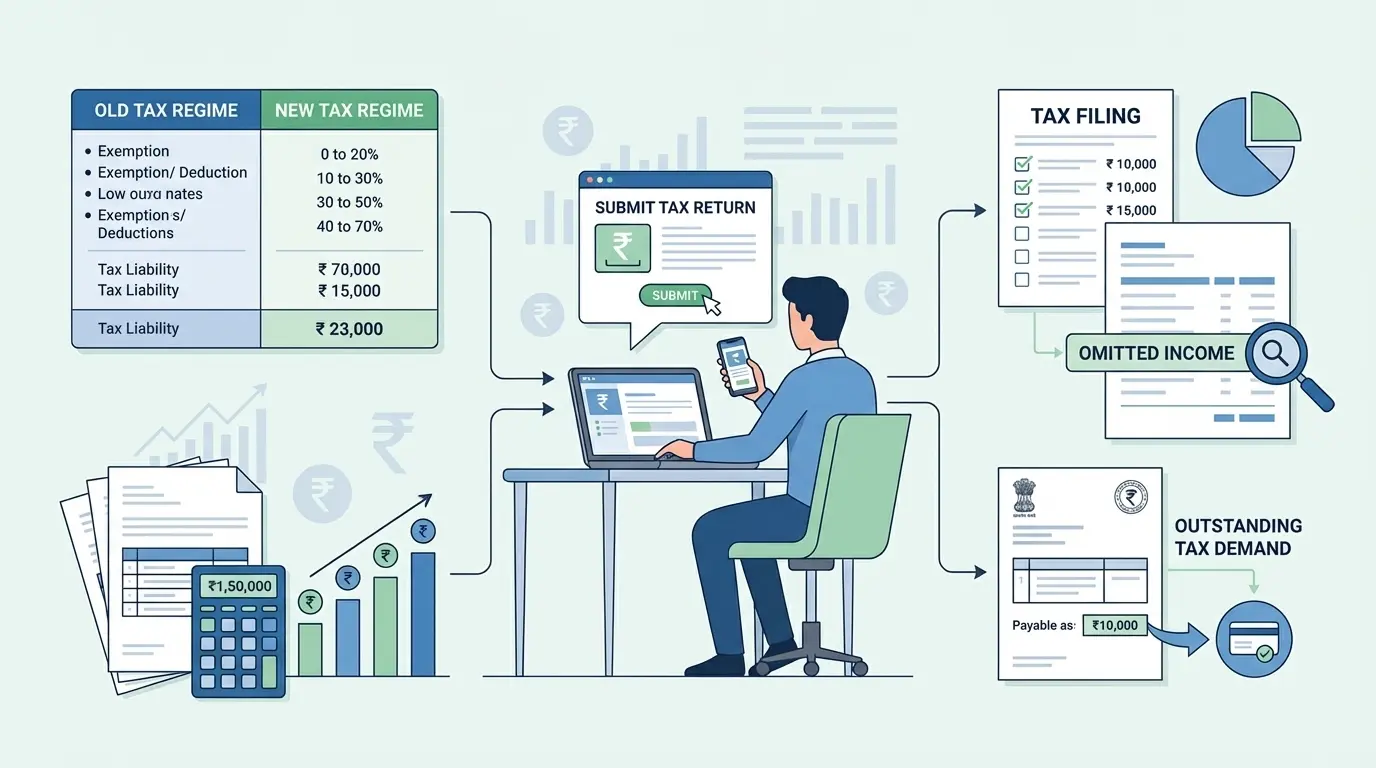
Several practical taxation concepts begin with the letter O. This section of the income tax glossary explains important terms such as Old Tax Regime, Online Tax Filing, Omitted Income and Outstanding Tax Demand in simple language for Indian taxpayers.
Old Tax Regime
The old tax regime refers to the traditional income tax system that allows taxpayers to claim various deductions and exemptions while calculating taxable income.
Explanation
Under the old tax regime, taxpayers can reduce their taxable income by claiming deductions and exemptions available under different provisions of the income tax law.
Common deductions and exemptions include:
- deductions for investments and savings
- house rent allowance (HRA)
- standard deduction
- interest on housing loans
- insurance premiums
Although the tax rates under the old regime may be higher, the availability of deductions can significantly reduce the overall tax liability.
Taxpayers can choose between the old tax regime and the new tax regime based on what is more beneficial for them.
Online Tax Filing
Online tax filing refers to the process of filing income tax returns electronically through the official tax filing portal.
Explanation
Most taxpayers in India now file their income tax returns online using digital platforms.
Online filing offers several advantages such as:
- faster processing of returns
- reduced chances of errors
- instant acknowledgment of submission
- easier tracking of refunds
Taxpayers must provide accurate details of income, deductions, and taxes paid while filing their returns online.
Omitted Income
Omitted income refers to income that a taxpayer has failed to report while filing their income tax return.
Explanation
Omitted income may occur due to:
- oversight or error
- lack of awareness
- incorrect reporting of income sources
Examples include:
- interest income not reported
- rental income omitted
- capital gains not declared
If income is omitted, the taxpayer may need to file a revised return or respond to notices issued by tax authorities.
Failure to report income may lead to penalties or additional tax liability.
Outstanding Tax Demand
Outstanding tax demand refers to the amount of tax that is due and payable by a taxpayer but has not yet been paid.
Explanation
Tax authorities may raise a demand if they determine that additional tax is payable.
This may arise due to:
- mismatch in income reported
- underpayment of taxes
- errors in tax calculation
Taxpayers can:
- pay the outstanding demand
- dispute the demand if incorrect
- request rectification if there is an error
It is important to resolve outstanding tax demands promptly to avoid further penalties or legal action.
Optional Tax Regime (New Tax Regime)
The optional tax regime refers to the alternative tax system introduced by the government that offers lower tax rates but removes most deductions and exemptions.
Explanation
Under this regime, taxpayers pay tax at reduced slab rates but cannot claim many common deductions and exemptions.
Key features include:
- lower tax rates compared to the old regime
- limited or no deductions allowed
- simplified tax calculation
Taxpayers must evaluate both regimes and choose the one that results in lower tax liability.
Offsetting of Losses
Offsetting of losses refers to the adjustment of losses against income to reduce overall taxable income.
Explanation
Tax laws allow taxpayers to set off losses against certain types of income.
For example:
- capital losses may be adjusted against capital gains
- business losses may be adjusted against business income
- house property losses may be adjusted within prescribed limits
If losses cannot be fully adjusted in the same year, they may be carried forward to future years subject to conditions.
Online Verification (ITR E-Verification)
Online verification refers to the process of confirming the authenticity of an income tax return after it has been filed electronically.
Explanation
After filing an income tax return, it must be verified to complete the filing process.
Verification can be done through:
- Aadhaar-based OTP
- net banking
- bank account validation
- demat account verification
If the return is not verified, it is treated as invalid.
Overdue Tax
Overdue tax refers to tax that has not been paid within the prescribed due date.
Explanation
When a taxpayer fails to pay taxes on time, the unpaid amount becomes overdue.
This may result in:
- interest charges
- penalties
- notices from tax authorities
Timely payment of taxes helps avoid additional financial burden.
One-Time Settlement (Tax Disputes)
One-time settlement refers to a scheme or provision that allows taxpayers to settle pending tax disputes by paying a specified amount.
Explanation
Such schemes are introduced by the government to reduce litigation and recover pending tax dues.
Under these schemes:
- taxpayers can resolve disputes
- penalties or interest may be reduced
- legal proceedings may be avoided
These are usually time-bound schemes.
Operational Income
Operational income refers to income generated from the core business activities of an entity.
Explanation
It includes revenue earned from regular business operations and excludes non-operating income such as:
- interest income
- capital gains
- one-time gains
Operational income is important for determining business profitability and taxable income.
Other Income (Residual Income Category)
Other income refers to income that does not fall under the primary heads of income defined under tax laws.
Explanation
This is similar to the concept of Income from Other Sources.
Examples include:
- interest income
- dividend income
- gifts received
- winnings from lotteries
This category ensures that all types of income are accounted for in taxation.


