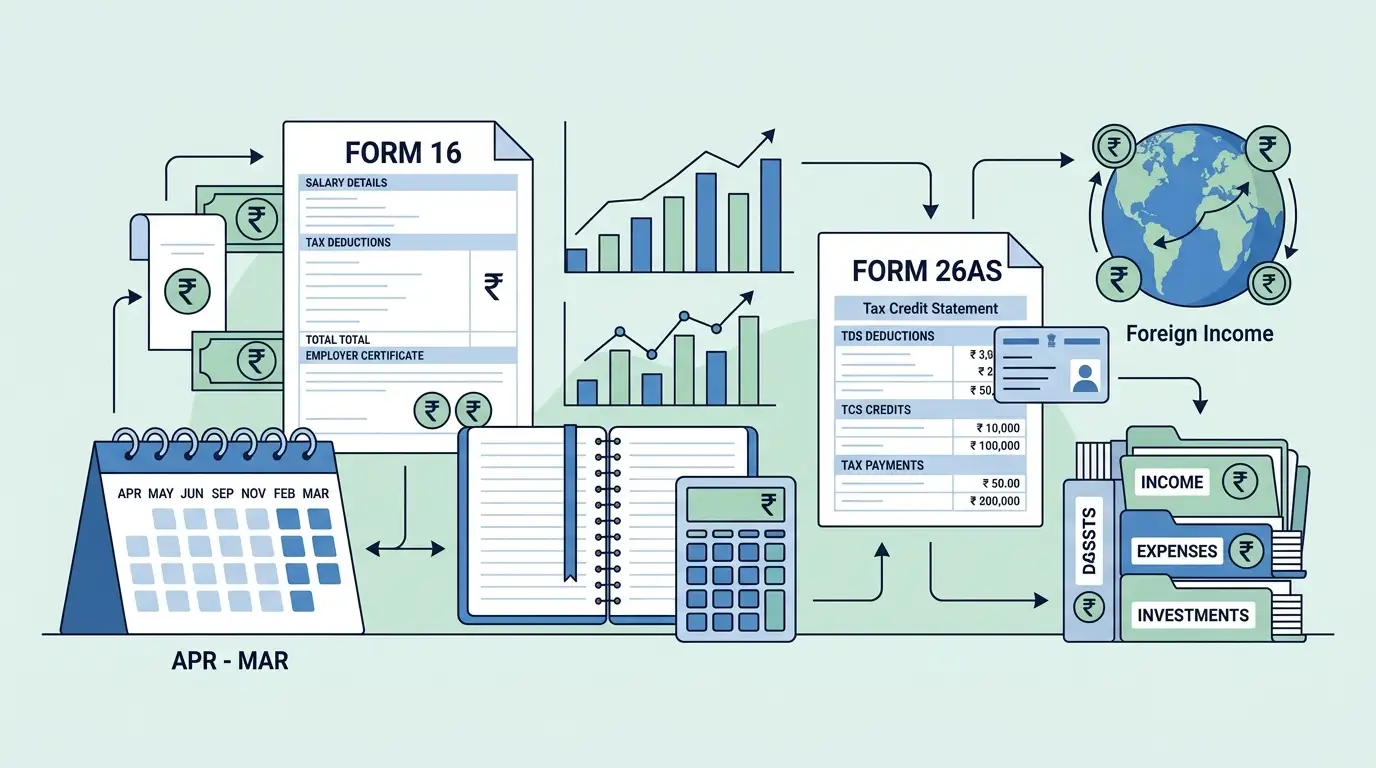
Income Tax Glossary F: Financial Year, Form 16, Form 16A
Several important income tax terms begin with the letter F. This section of the income tax glossary explains commonly used terms such as Financial Year, Form 16, Form 26AS, Foreign Income and Fringe Benefits in simple language for Indian taxpayers.
Financial Year (FY)
The financial year is the period during which income is earned and financial transactions are recorded for taxation purposes.
Explanation
In India, the financial year runs from 1 April to 31 March of the following year. All income earned during this period is considered when calculating the total income of a taxpayer.
After the financial year ends, taxpayers file their income tax returns in the following year known as the assessment year.
Example
Income earned between 1 April 2025 and 31 March 2026 belongs to Financial Year 2025–26.
Form 16
Definition
Form 16 is a certificate issued by an employer to employees showing the salary paid and tax deducted at source during the financial year.
Explanation
This document is one of the most important records for salaried taxpayers when filing their income tax returns.
It contains details such as:
Salary paid during the year
Tax deducted at source (TDS)
Deductions claimed
Employers usually issue Form 16 after the end of the financial year.
Form 16A
Form 16A is a certificate that shows tax deducted at source on income other than salary.
Explanation
It is issued by entities that deduct TDS on payments such as:
Interest income from banks
Professional fees
Commission or brokerage
Rent payments
Form 16A helps taxpayers verify the tax deducted and reported against their PAN.
Form 26AS
Form 26AS is a consolidated tax statement that shows all taxes deducted and deposited against a taxpayer’s PAN.
Explanation
This document acts as a record of tax credits available to the taxpayer.
It typically includes information such as:
TDS deducted by employers or banks
Advance tax paid
Self-assessment tax payments
High-value financial transactions
Taxpayers should review Form 26AS before filing their income tax returns to ensure the tax credits match their records.
Foreign Income
Foreign income refers to income earned by a taxpayer from sources located outside India.
Explanation
Foreign income may include earnings from:
Employment in another country
Foreign investments
Overseas business activities
Interest from foreign bank accounts
Whether this income is taxable in India depends on the residential status of the taxpayer and applicable tax rules.
Fringe Benefits
Fringe benefits are additional benefits provided by an employer to employees apart from their regular salary.
Explanation
Examples include:
Company car
Accommodation
Travel allowances
Stock options
Some fringe benefits may be taxable depending on the applicable tax provisions.
Filing Status
Filing status refers to the category under which a taxpayer files their income tax return.
Explanation
The filing status determines how income is reported and taxed.
Common taxpayer categories include:
Individual taxpayers
Hindu Undivided Family (HUF)
Firms and partnerships
Companies
For personal taxation, most people file returns under the individual taxpayer category.
Final Tax Liability
Final tax liability refers to the total tax payable by a taxpayer after calculating income, applying deductions, and adjusting taxes already paid.
Explanation
When filing an income tax return, the taxpayer calculates total tax liability and compares it with taxes already paid through:
Tax deducted at source (TDS)
Advance tax payments
Self-assessment tax payments
If the tax paid is less than the total liability, the remaining amount must be paid. If excess tax has been paid, the taxpayer may receive a refund.
Financial Transaction
A financial transaction refers to any monetary activity involving the transfer of money or assets between individuals or organizations.
Explanation
Examples of financial transactions include:
Purchase or sale of property
Investment in shares or mutual funds
Large bank deposits or withdrawals
Credit card payments and large purchases
Certain high-value financial transactions are reported to tax authorities for monitoring purposes.
Fiscal Policy
Fiscal policy refers to the government’s strategy for managing public finances through taxation and public spending.
Explanation
Fiscal policy influences economic growth, inflation, and employment levels.
Government actions under fiscal policy may include:
Changing tax rates
Introducing tax exemptions or incentives
Increasing or reducing public spending
Implementing economic stimulus measures
These decisions directly affect taxpayers through changes in tax rules and financial policies.