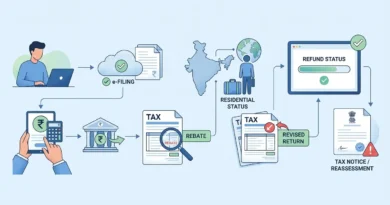
Income Tax Glossary E: E-Filing, E-Verification, Exemption
Many important income tax concepts beginning with the letter E relate to online tax filing and exemptions. This section of the income tax glossary explains terms such as E-Filing, E-Verification, Exemption, Equalisation Levy and other commonly used taxation terms in India.
E-Filing
E-filing refers to the process of submitting an income tax return electronically through the official online tax filing portal.
Explanation
Instead of submitting paper forms, taxpayers can file their income tax returns online through the portal of the Income Tax Department. E-filing has become the standard method for filing returns in India because it is faster, more convenient, and allows automatic validation of information.
Through e-filing, taxpayers can:
• report their income and deductions
• calculate tax liability automatically
• claim refunds
• track the status of their return
Most salaried individuals, freelancers, and business owners now file their returns using the e-filing system.
Example
A salaried employee logs into the tax portal, uploads salary details from Form 16, enters deductions, and submits the return online. This process is known as e-filing.
E-Verification
E-verification is the electronic confirmation of an income tax return after it has been filed.
Explanation
After filing an income tax return, the taxpayer must verify the return to confirm that the information submitted is correct. Without verification, the return is treated as incomplete and is not processed.
E-verification can be completed through several methods such as:
• Aadhaar OTP
• net banking authentication
• digital signature certificate
• electronic verification code (EVC)
Once the return is successfully verified, it is considered officially submitted and processing begins.
Exemption
An exemption is income that is completely excluded from taxation under specific provisions of the income tax law.
Explanation
Certain types of income are not taxed because the government provides exemptions to encourage specific economic activities or provide financial relief.
Examples of exempt income may include:
• certain allowances provided by employers
• agricultural income
• specified government benefits
Exempt income is not included when calculating taxable income.
Exempt Income
Exempt income refers to income that is not subject to income tax under the provisions of tax law.
Explanation
Even though this income may be received by a taxpayer, it is not included in the calculation of taxable income.
However, taxpayers may still need to report exempt income in their tax return for disclosure purposes.
Examples of exempt income may include:
- certain agricultural income
- specific allowances
- income exempt under special provisions of tax law
Expenditure
Expenditure refers to money spent by a taxpayer or business for operational, investment, or personal purposes.
Explanation
In business taxation, certain expenditures are allowed as deductions while calculating taxable profits.
Common examples of business expenditure include:
- rent for office or shop premises
- employee salaries and wages
- utility expenses
travel and marketing costs
Maintaining proper records of expenditure is important for accurate tax computation and compliance.
Expenditure Allowance
Expenditure allowance refers to expenses that are permitted as deductions when calculating taxable income.
Explanation
Certain expenditures are considered necessary for generating income and are therefore allowed as deductions under tax laws.
These allowances reduce the taxable income of the taxpayer and consequently lower the tax liability.
Equalisation Levy
Equalisation levy is a tax imposed on certain digital transactions involving non-resident companies providing online services to Indian users.
Explanation
With the growth of the digital economy, many foreign companies generate revenue from Indian users without having a physical presence in India. The equalisation levy was introduced to ensure that such companies pay tax on income earned from Indian markets.
This levy generally applies to services such as:
- online advertising
- digital platforms
- e-commerce services
Escaped Income
Escaped income refers to income that was not assessed or taxed during the original assessment.
Explanation
If the tax authorities later discover that certain income was not reported or assessed correctly, they may reopen the assessment and bring the escaped income under taxation.
Escaped income may occur due to:
- omission of certain income sources
- incorrect reporting of financial transactions
- errors in the original tax assessment
Estimated Income
Estimated income refers to income calculated based on projections or reasonable estimates rather than exact figures.
Explanation
Estimated income is commonly used when calculating advance tax. Since the exact income for the entire year may not yet be known, taxpayers estimate their total income and pay taxes accordingly.
Ex-Gratia Payment
An ex-gratia payment is a voluntary payment made by an employer or organization without any legal obligation.
Explanation
Such payments are typically made as a gesture of goodwill or financial support, often during retirement, layoffs, or special circumstances.
The tax treatment of ex-gratia payments depends on the nature of the payment and the applicable tax provisions.m