Income Tax Glossary B: Business Income, Turnoverur: Business Income, Turnoverur
Income tax terminology can often be confusing, especially for individuals filing taxes for the first time. This section of the income tax glossary explains important tax terms starting with the letter B including Basic Exemption Limit, Belated Return, Business Income, Business Loss, and other commonly used terms in Indian taxation.
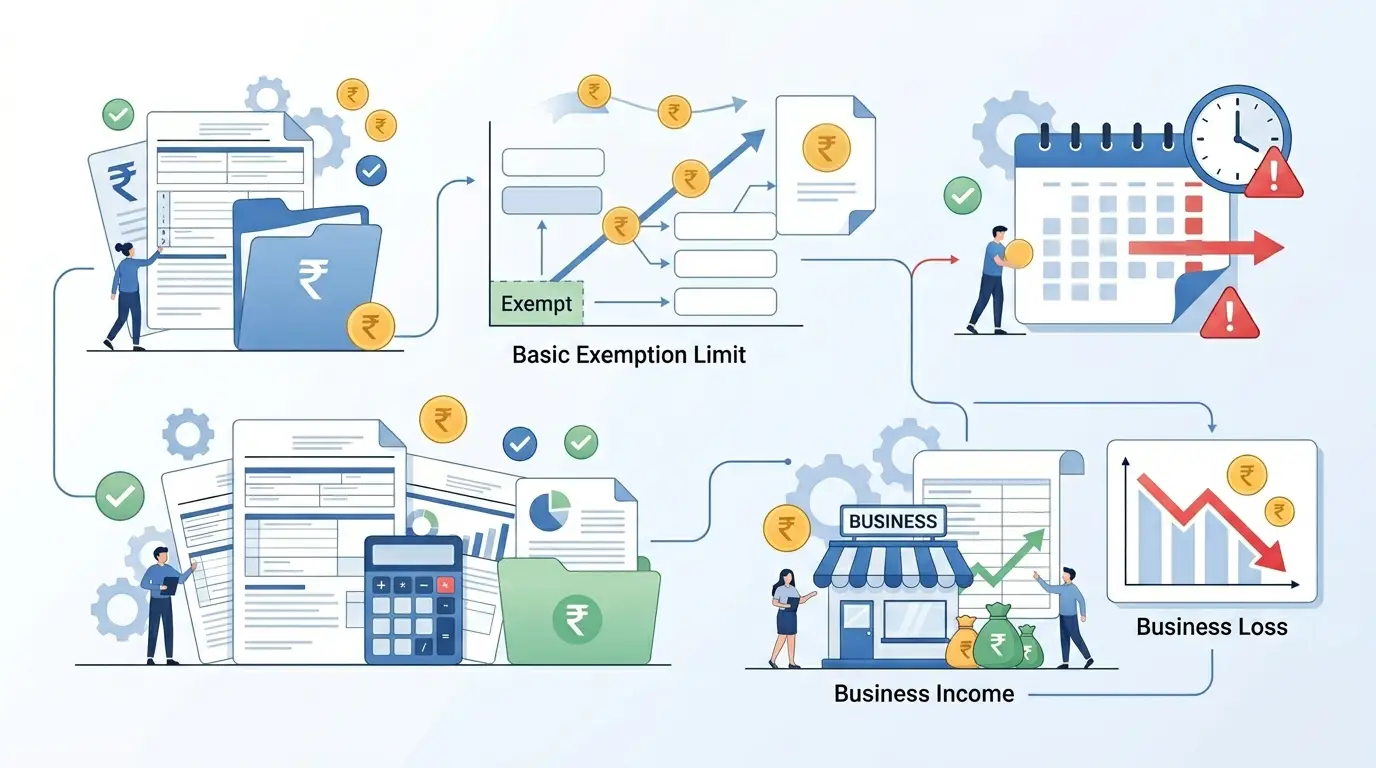
Basic Exemption Limit
The basic exemption limit is the maximum amount of income that an individual can earn in a financial year without being required to pay income tax.
Explanation
Income up to the basic exemption limit is not taxed. However, once your total income exceeds this limit, income tax is calculated according to the applicable tax slab rates.
The exemption limit may differ depending on:
• the tax regime chosen (old or new regime)
• the age of the taxpayer
For example, senior citizens often have higher exemption limits compared to younger taxpayers.
Even if your income is below the exemption limit, filing an income tax return may still be necessary in certain situations such as claiming a refund or reporting financial transactions.
Example
If the exemption limit is ₹3 lakh and a taxpayer earns ₹2.8 lakh during the financial year, no income tax is payable. If the income is ₹4 lakh, tax will apply on the amount above the exemption threshold according to slab rates.
Belated Return
A belated return is an income tax return that is filed after the original due date but before the final permitted deadline allowed by tax laws.
Explanation
The tax department sets a due date each year for filing income tax returns. If a taxpayer fails to submit the return by this date, they can still file it later as a belated return.
However, filing a belated return may result in certain consequences such as:
• late filing fees
• interest on unpaid taxes
• restrictions on carrying forward certain losses
Despite these drawbacks, filing a belated return is still better than not filing a return at all, as failure to file can lead to penalties and legal notices.
Example
If the due date for filing an income tax return is 31 July and a taxpayer submits the return in September, it will be treated as a belated return.
Best Judgment Assessment
Best judgment assessment is an assessment carried out by the tax authorities when a taxpayer fails to file a return or does not provide the required information during assessment proceedings.
Explanation
When the tax department does not receive sufficient information from the taxpayer, the assessing officer may estimate the taxpayer’s income based on available data and determine the tax liability accordingly.
This estimate may be based on:
• previous income records
• financial transactions reported to the department
• industry standards
• available documents
Since the income is estimated without full cooperation from the taxpayer, the assessed income may be higher than expected.
Example
If a business owner fails to file an income tax return despite earning significant income, the tax officer may estimate the income and determine tax liability through best judgment assessment.
Book Profit
Book profit refers to the profit shown in a company’s financial statements before certain tax adjustments are applied.
Explanation
Book profit is primarily used when calculating minimum tax payable by companies under certain provisions of tax law.
Companies may sometimes report low taxable income after claiming deductions and exemptions. To ensure that companies pay a minimum amount of tax, book profit is used as a reference point for calculating tax under special rules.
Although this concept mainly applies to companies, it is an important term within the income tax framework.
Example
A company may report accounting profit of ₹5 crore in its financial statements but show lower taxable income after deductions. Book profit helps determine the minimum tax payable.
Business Income
Business income refers to profits earned from carrying out commercial activities such as trading, manufacturing, or providing services.
Explanation
Business income is calculated by subtracting allowable business expenses from the total revenue generated by the business.
Common business expenses include:
• rent for business premises
• employee salaries
• cost of goods purchased
• utilities and operational costs
• marketing expenses
After deducting these expenses, the remaining amount represents the net profit of the business, which becomes taxable under the head “Profits and Gains from Business or Profession”.
Example
If a shop generates revenue of ₹20 lakh during the year and business expenses total ₹14 lakh, the business income is ₹6 lakh.
Business Loss
Business loss occurs when the total expenses incurred in running a business exceed the revenue generated during a financial year.
Explanation
When a business makes a loss, tax laws allow the taxpayer to adjust this loss against certain types of income. If the loss cannot be fully adjusted in the same year, it may be carried forward to future years and set off against future profits.
This provision helps businesses reduce tax liability in profitable years after experiencing losses.
Example
If a business earns ₹8 lakh in revenue but spends ₹10 lakh on operational expenses, the business incurs a loss of ₹2 lakh.
Balance Tax Payable
Balance tax payable refers to the remaining tax liability that must be paid after adjusting taxes already paid during the year.
Explanation
During a financial year, taxes may already be paid through several mechanisms such as:
• TDS deducted by employers or banks
• advance tax payments
• tax credits
After calculating the final tax liability while filing the income tax return, the taxpayer must compare this liability with taxes already paid. If the taxes already paid are lower than the total tax liability, the remaining amount becomes the balance tax payable.
Example
If total tax liability is ₹60,000 and TDS deducted during the year is ₹45,000, the remaining ₹15,000 becomes the balance tax payable.
Business Turnover
Business turnover refers to the total value of goods sold or services provided by a business during a financial year.
Explanation
Turnover represents the gross receipts of a business before deducting expenses.
It is an important metric because several tax provisions depend on the level of turnover, including:
• requirement for tax audit
• eligibility for presumptive taxation schemes
• compliance requirements
Higher turnover businesses are generally subject to stricter reporting requirements.
Example
If a business sells products worth ₹50 lakh during the year, its turnover is ₹50 lakh regardless of the profit earned.
Block Assessment
Block assessment is a special procedure used by the tax authorities to determine undisclosed income discovered during search or investigation operations.
Explanation
When the tax department conducts a search and finds evidence of hidden income, it may assess income for multiple years together under a block assessment.
This method helps authorities determine the total undisclosed income for a specified block period and calculate the tax payable on that income.
Benami Property
Benami property refers to property that is purchased in the name of one person while the payment for that property is made by another person.
Explanation
Such arrangements are often used to conceal the real ownership of assets. To prevent tax evasion and illegal financial activities, strict laws regulate benami transactions.
If authorities determine that a property is held benami, the property may be confiscated and legal action may be taken against the individuals involved.
Example
If a person buys a property using their own money but registers it in the name of someone else to hide ownership, it may be considered a benami property.