
Income Tax Glossary C: Capital Gains, Capital Asset, CII Explained
Many important income tax concepts begin with the letter C. This section of the income tax glossary explains commonly used terms such as Capital Asset, Capital Gains, Cost Inflation Index, Carry Forward Loss, and Clubbing of Income in simple language for Indian taxpayers.
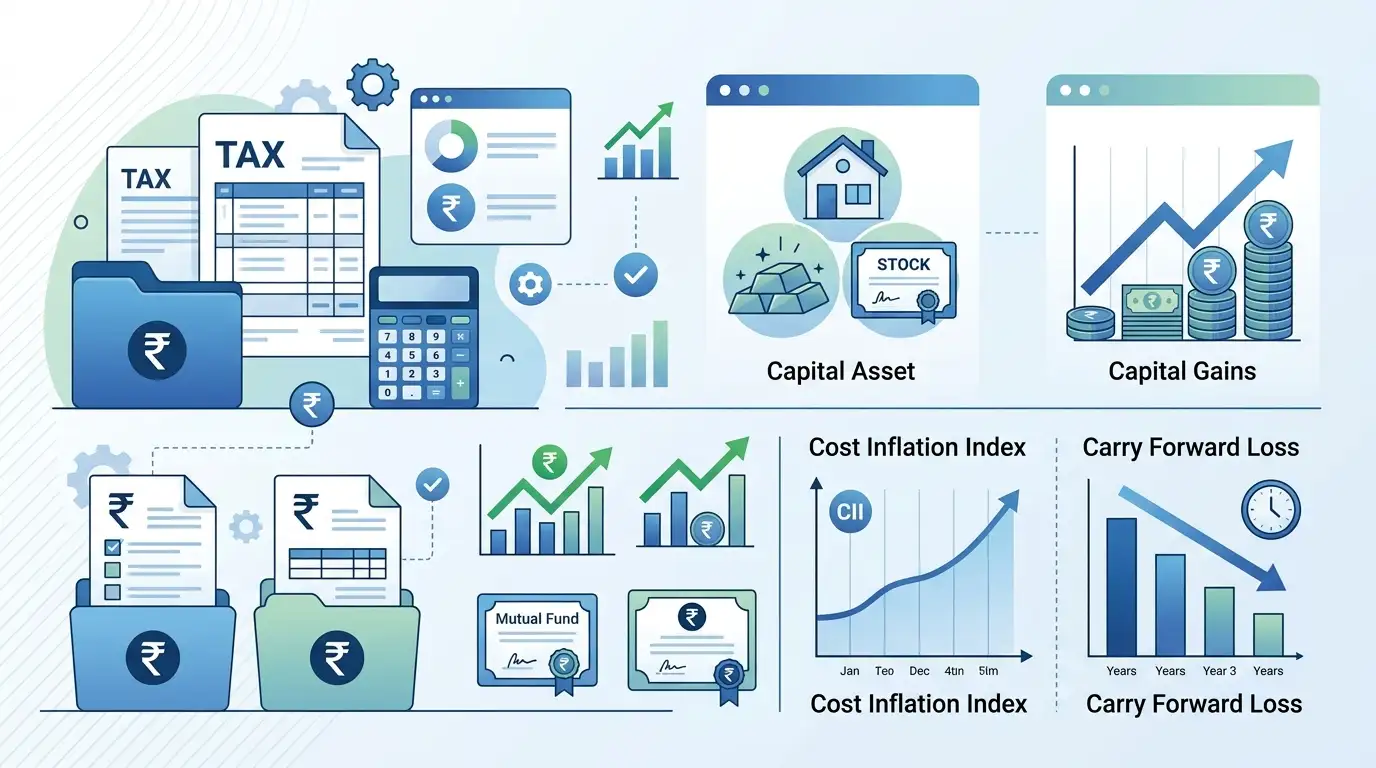
Capital Asset
A capital asset is any property or investment owned by a taxpayer that can generate capital gains when sold.
Explanation
Capital assets include both financial and physical assets such as:
• shares and stocks
• mutual funds
• real estate
• gold and jewellery
• bonds and securities
• certain digital assets such as cryptocurrencies
When a capital asset is sold, the difference between the purchase price and the selling price determines whether the taxpayer has made a capital gain or capital loss.
Example
If an investor buys shares for ₹1 lakh and later sells them for ₹1.4 lakh, the shares are capital assets and the ₹40,000 profit is considered capital gain.
Capital Gains
Capital gains refer to the profit earned when a capital asset is sold at a price higher than its purchase cost.
Explanation
Capital gains arise only when an asset is sold or transferred. The tax treatment of these gains depends on the type of asset and how long the asset was held before selling.
Capital gains are generally classified into:
- short-term capital gains
- long-term capital gains
Different tax rates apply depending on the classification.
Capital Loss
Capital loss occurs when a capital asset is sold for a price lower than its purchase price.
Explanation
Tax laws allow capital losses to be adjusted against capital gains to reduce the overall tax liability. If the loss cannot be fully adjusted in the same year, it may be carried forward to future years.
Capital Expenditure
Capital expenditure refers to spending incurred to acquire, upgrade, or improve a long-term asset.
Explanation
These expenses are not treated as regular business expenses because they provide benefits over several years.
Examples include:
- purchase of machinery
- purchase of buildings
- purchase of vehicles for business
Capital expenditure usually increases the value of the asset and may affect the calculation of capital gains when the asset is sold.
Capital Receipts
Capital receipts are funds received by a taxpayer that are not part of normal business income.
Explanation
Capital receipts are generally associated with capital transactions such as:
- sale of a capital asset
- loans received
- investment capital introduced into a business
Some capital receipts may not be taxable unless specifically covered under tax provisions.
Capital Gain Tax
Capital gain tax is the tax levied on profits arising from the sale of capital assets.
Explanation
The rate of capital gains tax depends on:
- the type of asset
- the holding period of the asset
- applicable tax rules
Different rules apply to assets such as property, shares, mutual funds, and other investments.
Carry Forward Loss
Carry forward loss refers to the ability to transfer a loss from one financial year to future years for tax adjustment.
Explanation
If a taxpayer incurs certain losses during a financial year and cannot fully adjust them against income in the same year, those losses can be carried forward to future years.
This helps reduce tax liability in years when the taxpayer earns profits.
Cost of Acquisition
Cost of acquisition refers to the original price paid to purchase a capital asset.
Explanation
When calculating capital gains, the cost of acquisition is deducted from the selling price of the asset.
Additional expenses such as brokerage or stamp duty may also be considered part of the acquisition cost in certain cases.
Cost of Improvement
Cost of improvement refers to expenses incurred to improve or increase the value of a capital asset.
Explanation
These expenses can be added to the cost of acquisition when calculating capital gains, thereby reducing the taxable profit.
Examples include:
- renovation of property
- structural improvements
- major repairs that increase asset value
Cost Inflation Index (CII)
Cost Inflation Index is a number used to adjust the purchase cost of certain assets for inflation when calculating long-term capital gains.
Explanation
Inflation reduces the real value of money over time. To account for this, tax laws allow the cost of acquisition to be adjusted using the Cost Inflation Index.
This adjustment is called indexation.
Indexation reduces the taxable capital gain by increasing the effective purchase cost of the asset.
Example
If a property was purchased many years ago, the indexed cost may be significantly higher than the original purchase price, which lowers the taxable capital gain.
Computation of Income
Computation of income refers to the process of calculating taxable income under the income tax law.
Explanation
Income must be computed separately under different heads such as:
- salary
- house property
- business or profession
- capital gains
- other sources
After computing income under each head, deductions are applied to arrive at taxable income.
Clubbing of Income
Clubbing of income refers to a rule under which the income of one person may be included in the taxable income of another person in certain cases.
Explanation
These rules are designed to prevent tax avoidance through the transfer of income or assets to relatives.
Common situations include:
- income from assets transferred to a spouse
- income of a minor child
- income from transferred assets without adequate consideration
Capital Market
Capital market refers to the financial market where long-term securities such as shares, bonds, and debentures are traded.
Explanation
Transactions in the capital market often result in capital gains or losses for investors, which may have tax implications under income tax laws.
