
How Many Credit Cards Should You Have in India? The Safe Limit Explained
Many Indians today hold more than one credit card, but very few know how many are actually safe to maintain.
Some believe that owning multiple cards improves their CIBIL score. Others assume that more cards automatically increase the risk of debt. The truth is more practical and depends entirely on how responsibly those cards are managed.
There is no universal number that works for everyone. The right limit depends on your income stability, repayment discipline, total credit utilisation, and ability to manage multiple billing cycles without stress. While banks may approve several cards based on your credit profile, approval does not automatically mean suitability.
For most salaried individuals in India, the ideal number balances flexibility with control. In this guide, we will break down the safe range, how multiple credit cards affect your CIBIL score, and how to decide the right number for your financial situation.
A credit card is a short-term borrowing facility provided by a bank or financial institution. When you swipe it, you are not using your own money. You are temporarily borrowing the bank’s money up to a pre-approved credit limit.
At the end of the billing cycle, the bank generates a statement showing:
Total purchases
Outstanding balance
Minimum amount due
Final payment deadline
If you pay the entire outstanding balance before the due date, you pay zero interest.
If you carry forward even a small balance, interest begins accumulating. In India, credit card interest rates are among the highest in retail finance, often exceeding 30 percent annually. This is why understanding the system before applying is critical.
Should You Own a Credit Card in India
For most salaried and financially disciplined individuals, the honest answer is yes, owning at least one credit card is beneficial. However, this recommendation comes with an important condition: you must have the financial maturity to treat borrowed money with respect.
A credit card makes the most sense if you have a stable monthly income, a habit of paying bills on time, and the ability to track your expenses regularly. In such cases, the card becomes a powerful tool that helps build your credit history and improves your eligibility for future loans such as home loans and car loans.
On the other hand, if your income is irregular, your monthly budget frequently goes off track, or you already struggle with EMIs, it is wiser to pause. Credit cards amplify existing financial behaviour. If your money management is weak today, adding a credit card often accelerates the problem rather than solving it.
In simple terms, credit cards reward discipline and punish carelessness. Before applying, it is worth doing an honest self check.
How Credit Cards Actually Work
Many people use credit cards for years without fully understanding how the billing system operates. This knowledge gap is one of the biggest reasons users fall into high interest debt.
When a bank issues a credit card, it assigns you a pre-approved credit limit, which is essentially short-term borrowing power. Every time you swipe the card, you are temporarily borrowing the bank’s money, not spending your own savings.
The most important concept to understand is the interest free period. If you pay the entire outstanding amount before the due date, the bank does not charge interest on your purchases. This is why financially disciplined users can enjoy credit cards at almost zero cost.
However, the moment you carry forward even a small unpaid balance, interest begins to accumulate on the remaining amount. Credit card interest in India is notoriously high, which is why partial payments can quickly become expensive.
Understanding the Billing Cycle, Statement Date, and Due Date

Many people use credit cards without fully understanding the billing cycle. This lack of clarity is one of the biggest reasons people fall into debt.
Every card issuer follows a monthly structure:
- Spending Period: This is the duration during which you use your card to make purchases before your monthly statement is generated.
- Statement Date: This is the date when the bank calculates your total spending and issues your credit card bill.
- Grace Period: This is the interest-free window between the statement date and the payment due date. Paying the full amount during this period avoids interest.
- Payment Due Date: This is the final deadline by which you must clear your outstanding balance to avoid late fees and interest charges.
If you pay the full bill before the due date, you effectively use the bank’s money at zero cost.
If you pay only the minimum due, interest starts accumulating immediately on the remaining balance. This is where most financial problems begin.
Credit Card Benefits: When They Truly Work in Your Favour
When used responsibly, they offer several meaningful advantages for consumers.
One of the biggest benefits is the ability to build and improve your CIBIL score. Lenders in India place heavy weight on your repayment history. Regular, on time payments signal financial discipline and can improve your chances of getting larger loans at better interest rates in the future.
They provide short-term liquidity during emergencies. If an unexpected medical bill or urgent travel expense arises just before your salary arrives, it can act as a temporary buffer, provided you clear the dues promptly.
In addition, many credit cards offer cashback, reward points, fuel surcharge waivers, and airport lounge access. For users who already have planned expenses, these benefits can translate into real savings.
Another often overlooked advantage is better fraud protection compared to debit cards. Since the bank’s money is used first, disputes are generally easier to handle than when money is directly debited from your savings account.
When Credit Cards Become Dangerous
Despite the benefits, credit cards can become financially damaging when used without discipline. The biggest trap is the minimum payment illusion.
Banks prominently display a small “minimum due” amount on statements. Many users mistakenly believe paying this keeps them safe. In reality, paying only the minimum allows the bank to charge interest on the remaining balance, often at very high rates. Over time, this can snowball into a heavy debt burden.
Another common risk is lifestyle inflation. Because the spending feels frictionless, many users gradually begin purchasing items they would never buy with cash. This silent behavioural shift is responsible for a large portion of credit card debt problems in India.
The final danger is the debt snowball effect. Once balances start rolling over month after month, interest compounds rapidly. At that stage, clearing the card can become psychologically and financially stressful.
How Many Credit Cards Should You Have in India
There is no fixed number that automatically becomes “too many.” For one person, four cards may be manageable. For another, even two may feel overwhelming.
Instead of focusing on a number, it is more useful to focus on capacity and control.
For most, once you cross three to five active cards, complexity begins to increase significantly. Each additional card adds:
A separate billing cycle
A different statement date
A different payment due date
Separate reward tracking
Potential annual fees
The real problem is not ownership. It is management failure.
Credit cards become “too many” when:
You miss even one payment in a year
You are unsure of your total outstanding balance
Your total credit utilisation regularly crosses 30 to 40 percent
You open new cards without a specific purpose
You keep cards only for welcome bonuses
Another clear warning sign is mental stress. If you need reminders, spreadsheets, and constant monitoring just to stay organised, you may have exceeded your safe limit.
For most salaried professionals in India, more than five cards rarely adds meaningful financial benefit. At that stage, the marginal rewards are small, but the administrative risk increases.
The safe limit is not about how many banks trust you with credit. It is about how many you can manage without affecting:
Your repayment discipline
Your CIBIL score
Your financial stability
If managing your cards feels complicated, that is usually your signal to simplify.
Does Having Multiple Credit Cards Hurt Your CIBIL Score?
This is one of the most common misconceptions in India.
Simply owning multiple credit cards does not automatically hurt your CIBIL score. What affects your score is not the number of cards, but how you manage them.
To understand this clearly, you need to know how your CIBIL score is calculated.
How CIBIL Score Is Structured
Your credit score is broadly influenced by the following factors:
Payment history (largest impact)
Credit utilisation ratio
Length of credit history
Credit mix
New credit enquiries
Notice something important. The number of credit cards is not a direct scoring factor.
What matters is behaviour.
When Multiple Credit Cards Can Actually Improve Your Score
Having more than one credit card can be beneficial if managed responsibly.
First, it increases your total available credit. This helps reduce your overall credit utilisation ratio. A lower utilisation ratio is viewed positively by credit bureaus.
For example, if you have one card with a ₹1 lakh limit and spend ₹50,000, your utilisation is 50 percent. That is relatively high.
But if you have three cards with a combined limit of ₹3 lakh and still spend ₹50,000, your utilisation drops to around 17 percent. That is considered healthy.
Second, multiple well-managed accounts can strengthen your payment history over time. Consistently paying all cards on time signals strong credit discipline.
Third, older credit cards contribute to a longer credit history, which positively impacts your score.
When Multiple Credit Cards Can Hurt Your Score
The risk appears when discipline weakens.
Multiple credit cards can negatively impact your CIBIL score if:
You miss even one payment
You frequently apply for new cards, triggering multiple hard enquiries
Your total utilisation becomes high across cards
You close very old cards, shortening your credit history
Hard enquiries occur each time you apply for a new credit product. Too many enquiries within a short period can temporarily lower your score.
The bigger danger, however, is missed payments. Payment history carries the highest weight in your credit score calculation. Even one delayed payment can cause a noticeable drop.
The Real Conclusion
Owning multiple credit cards does not harm your CIBIL score by default.
Poor management does.
If you:
Pay all dues on time
Keep total utilisation below 30 percent
Avoid unnecessary credit applications
then holding two to three credit cards can actually support a healthy credit profile.
The card count itself is neutral. Financial behaviour determines the outcome.
Credit Score and Regulatory Perspective
To understand the impact of multiple credit cards properly, it is important to look at how credit scoring works in India.
In India, credit scores issued by credit bureaus such as CIBIL typically range from 300 to 900. Most banks and financial institutions prefer a score of 750 or above when approving loans or offering better interest rates. Maintaining responsible credit behaviour is therefore critical if you plan to apply for a home loan, car loan, or business loan in the future.
Payment history carries the highest weight in your credit score calculation. Even a single delayed payment can negatively impact your score and remain on your credit report for years. This is why managing multiple credit cards requires consistent discipline.
It is also important to understand the cost of mismanagement. Credit card interest rates in India generally range between 30 percent and 45 percent annually if balances are carried forward. This makes unpaid credit card debt one of the most expensive forms of retail borrowing.
As per regulatory norms, banks report your repayment behaviour to credit bureaus regularly. Missed payments, high utilisation, and frequent credit applications are all recorded. This reporting system is designed to protect lenders, but it also means that financial discipline directly affects your borrowing power.
For this reason, the number of credit cards you hold is less important than how responsibly you manage them.
Understanding Credit Utilisation Ratio and Why It Matters More Than Card Count
If you remember only one concept from this entire article, let it be this:
Credit utilisation ratio matters far more than the number of credit cards you own.
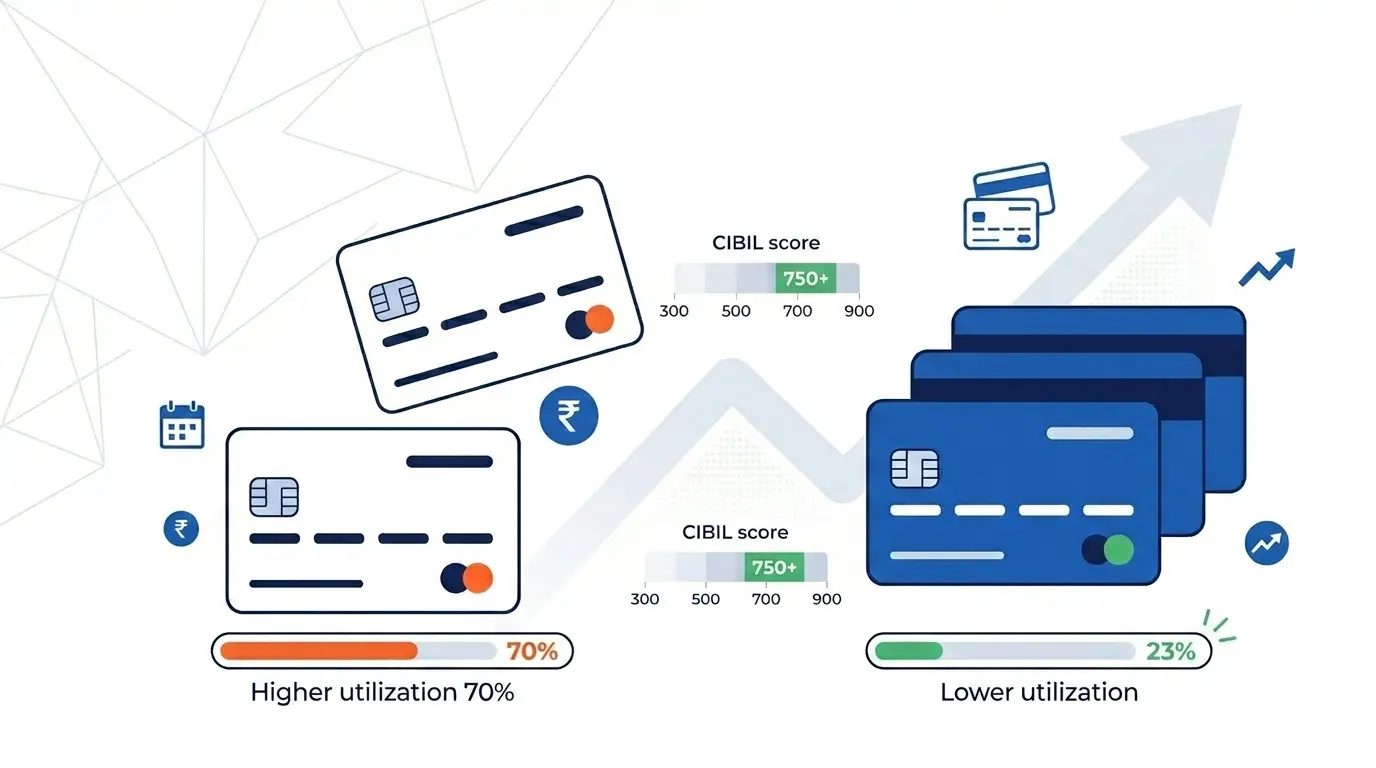
Credit utilisation ratio is the percentage of your total available credit that you are currently using. It is calculated by dividing your total outstanding balance by your total credit limit across all cards.
How It Is Calculated
Let us look at a practical example.
Suppose you have:
One credit card
Credit limit of ₹1,00,000
You spend ₹70,000
Your credit utilisation ratio is 70 percent.
From a lender’s perspective, this indicates heavy reliance on borrowed money. Even if you pay on time, consistently high utilisation can signal financial stress.
Now consider a second scenario.
You have:
Three credit cards
Combined credit limit of ₹3,00,000
You still spend ₹70,000 in total
Your utilisation drops to approximately 23 percent.
The spending has not changed. Only your available credit has increased. Yet your credit profile now appears significantly healthier.
This is why utilisation ratio often matters more than card count.
Why 30 Percent Is Often Considered the Safe Zone
Most credit experts recommend keeping utilisation below 30 percent of your total available limit.
Here’s why:
High utilisation signals financial dependency on credit
Lower utilisation indicates better cash flow control
It reduces perceived risk from a lender’s perspective
If your utilisation consistently crosses 50 to 60 percent, lenders may interpret this as credit stress, even if you are paying on time.
Why This Matters More Than the Number of Cards
You could have:
One card with 80 percent utilisation
orThree cards with 20 percent combined utilisation
The second scenario is usually healthier for your credit profile.
This is why asking “how many credit cards should you have in India” is not complete without asking:
How much of your available credit are you using?
A person with three low-utilisation cards is often financially safer than someone with one maxed-out card.
The Important Caution
Higher total credit limit should not become an excuse for higher spending.
The goal of having multiple cards is to reduce utilisation ratio, not to increase consumption.
If your spending rises with your limit, the benefit disappears.
Practical Tip
If your utilisation regularly crosses 30 percent, you have two options:
Reduce monthly credit card spending
Increase your total available credit responsibly
Both approaches improve your credit profile. But increasing credit should only be done if repayment discipline is strong.
In short, credit utilisation ratio is one of the strongest factors affecting your CIBIL score. The number of cards is secondary. Control over usage is primary.
Smart Credit Card Rules Everyone Must Follow
To use credit cards safely, a few non negotiable habits must be followed.
First, always pay the full outstanding amount, not just the minimum due. This single habit protects you from high interest charges and keeps your credit profile clean.
Second, try to keep your credit utilisation below 30 percent of your total limit. This signals responsible credit behaviour and supports a healthy CIBIL score.
Third, enable auto pay from your bank account to avoid accidental missed payments. Even financially disciplined people occasionally forget due dates.
Fourth, review your monthly statements carefully. Hidden subscriptions, incorrect charges, and fraudulent transactions are easier to catch early.
Finally, periodically review your cards and close those with high annual fees and poor benefits, but think carefully before closing your oldest card since it contributes to your credit history length.
Common Credit Card Mistakes Indians Make
Across India, certain patterns repeat again and again.
Many users treat their credit limit as if it were additional income. This mindset often leads to overspending. Others fall into the trap of paying only the minimum due, unaware of the heavy interest accumulating in the background.
Another frequent mistake is blindly chasing reward points. Spending ₹10,000 extra just to earn a small cashback rarely makes financial sense. Rewards should complement your normal spending, not drive unnecessary purchases.
Aggressive sales tactics during festive seasons also lead many people to take multiple cards they do not actually need. Over time, annual fees from unused cards quietly eat into savings.
Avoiding these common pitfalls already puts you ahead of a large portion of credit card users.
Best Strategy for Beginners
If you are new to credit cards, the safest approach is to start small and build gradually. Begin with one lifetime free card from a reputed bank. Use it only for routine, budgeted expenses such as fuel, groceries, or utility bills.
Focus for the first 12 to 18 months on maintaining perfect payment discipline and keeping utilisation low. Once you have built a solid repayment track record and understand your spending patterns, you can evaluate whether adding a second card provides real value.
This slow and structured approach dramatically reduces the risk of falling into expensive debt cycles.
Conclusion
Credit cards are powerful financial tools, but they demand responsibility. For disciplined users, they offer convenience, rewards, improved credit scores, and short-term financial flexibility. For careless users, they can quickly become one of the most expensive forms of consumer debt in India.
If you have stable income and strong repayment habits, owning one well managed credit card is usually a smart financial move. As your experience grows, you may add more cards strategically, but only if you can manage them comfortably.
Remember the core principle that experienced investors and lenders quietly follow:
One properly managed credit card will always outperform multiple poorly handled cards.
Use credit wisely, and it becomes a powerful ally in your financial journey.
FAQs
Yes, most salaried individuals in India should own one credit card if they have stable income and can pay the full bill on time. A well-managed credit card helps build CIBIL score, improves loan eligibility, and offers rewards like cashback and lounge access. However, people who struggle with overspending or irregular income should avoid credit cards until their finances stabilise.
For most Indians, the ideal number of credit cards depends on financial discipline and usage needs:
Beginners: 1 credit card
Regular users: 2 to 3 credit cards
Advanced users: 3 to 5 credit cards (only with strong payment discipline)
Having multiple credit cards is not harmful by itself. Problems arise only when payments are missed or utilisation becomes too high.
No, having multiple credit cards is not bad if they are managed responsibly. In fact, multiple cards can improve your credit score by increasing total available credit and lowering utilisation ratio. However, applying for too many cards quickly or missing payments can negatively impact your CIBIL score.
Yes. Owning and properly using a credit card can improve your CIBIL score because it builds payment history and credit mix. The key requirement is to pay the full bill on time every month and maintain low credit utilisation. Missed payments, however, can quickly damage your score.
The safest way to use a credit card is to treat it like a debit card. Spend only what you already have in your bank account, pay the full bill before the due date, keep utilisation below 30 percent, and enable auto pay to avoid missed payments.
If you pay only the minimum due, the remaining balance starts attracting high interest, often between 30 percent and 45 percent annually in India. This can quickly snowball into expensive long term debt. Always aim to pay the full outstanding amount.
