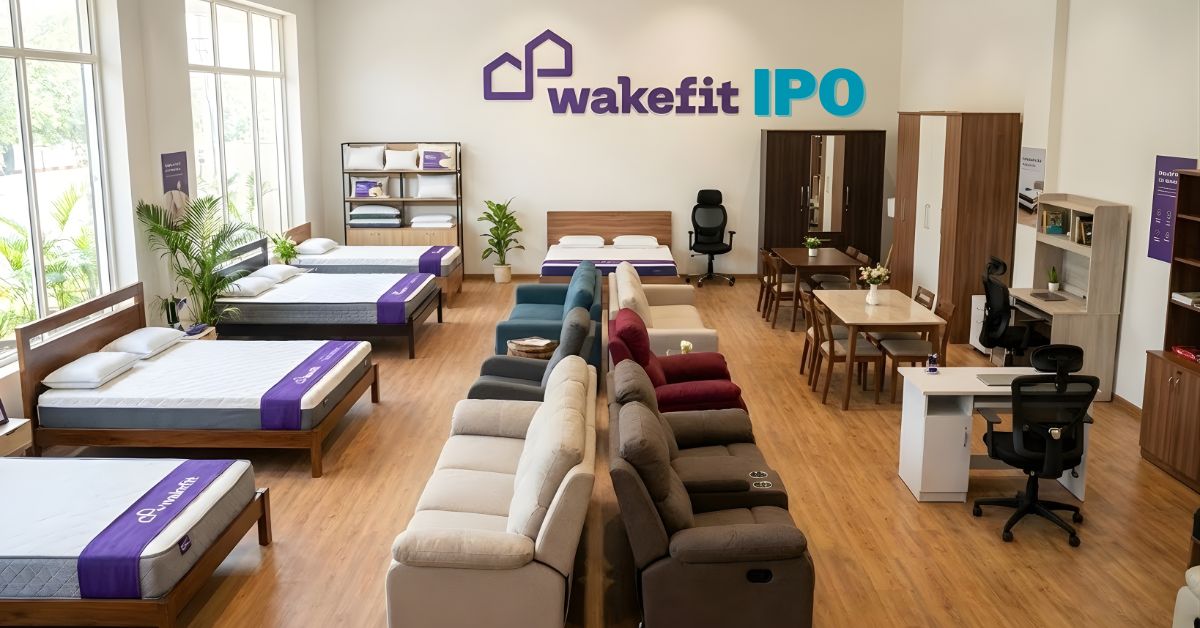
Wakefit IPO Review 2025: Price Band, GMP, Dates, Financials

Wakefit Innovations Ltd.
Wakefit IPO Details
IPO Open
8 December 2025
IPO Close
10 December 2025
Price Band
₹185 – ₹195
Issue Size
₹1,288.89 Cr
Listing on
BSE, NSE
Min. Lot Size
76
Face value
₹1
GMP
₹36
Key Performance Indicators
Market Cap
₹6,373.16 Cr.
P/E
N/A
EPS
₹1.58(restated)
ROE
-6.58%
ROCE
-0.68%
Sector
Home & Furniture
Wakefit IPO Timeline
The Wakefit IPO listing date is expected to be December 15 2025, with allotment finalized on December 11 2025.
Introduction
Wakefit Innovations Limited is one of India’s fastest-growing direct-to-consumer (D2C) brands in the home and sleep solutions market. Best known for its mattresses, pillows, and ergonomic furniture, the company has built a strong digital-first model that serves customers across India through online channels, efficient supply chains, and in-house manufacturing capabilities. With millions of customers and a strong brand recall in the home-comfort segment, Wakefit has positioned itself as a modern, value-driven alternative to traditional furniture and mattress players.
The company operates across multiple product categories including mattresses, sleep accessories, home furniture, work-from-home setups, and interior solutions. Wakefit’s ability to combine affordability with high product quality has allowed it to scale significantly, especially in India’s booming Tier-1 and Tier-2 cities. Its omnichannel strategy, supported by online platforms and experience stores, further strengthens customer access and brand trust.
The Wakefit Innovations IPO aims to raise capital primarily to expand manufacturing capacity, strengthen branding, enhance working capital, and support overall growth. With strong revenue momentum, rising EBITDA performance, and a growing customer base, the Wakefit Innovations IPO is drawing significant interest from investors seeking exposure to India’s fast-expanding D2C and home-furnishing sectors.
About Wakefit Innovations Ltd.
Founding and History
Wakefit Innovations Limited was founded in 2016 in Bengaluru by Ankit Garg and Chaitanya Ramalingegowda. The company began with a simple mission: to bring affordable, research-backed sleep and home products directly to Indian consumers. Starting as a mattress-focused startup, Wakefit expanded rapidly through digital channels and became one of India’s most recognised D2C brands in the home and furniture category. Over the years, the company has scaled its operations, expanded its manufacturing capacity, and built a strong online presence across the country.
Business Model
Wakefit operates a direct-to-consumer (D2C) business model supported by in-house manufacturing, efficient supply chain systems, and strong digital distribution. Products are sold through the company’s website, major e-commerce platforms, and its growing chain of physical experience stores. The model allows Wakefit to maintain higher control over quality, reduce distribution costs, and offer competitive pricing compared to traditional retail-based furniture brands.
Brand and Market Positioning
Wakefit positions itself as an affordable, high-quality home solutions brand focused on comfort, durability, and smart design. It appeals strongly to urban and semi-urban customers seeking budget-friendly, modern home products. With strong brand recall in the mattress and sleep segment, Wakefit has extended its positioning to home furniture, workstation setups, and lifestyle home products.
Products and Services
Wakefit’s top product categories include:
Mattresses (Orthopedic, Dual Comfort, Foam-based)
Beds and Storage Furniture
Sofas and Recliners
Pillows, Cushions, and Sleep Accessories
Wardrobes, Study Tables, Work-from-Home Furniture
Home Décor Products and Accessories
Sleep Solutions & Interior Concepts
Flagship Offerings
Wakefit’s flagship products are its Orthopedic Memory Foam Mattresses, widely known for comfort and affordability. The brand is also gaining strong traction in sofa sets, beds, and ergonomic work-from-home furniture, which have become major contributors to its revenue in recent years.
Revenue Profile
Wakefit derives the majority of its revenue from the sale of mattresses and furniture. Over time, the furniture segment has contributed an increasing share of the company’s total income, supported by rising demand for home improvement and online furniture purchases. The brand continues to maintain strong margins in sleep solutions while scaling rapidly in furniture and home categories.
Geographical Footprint
Wakefit sells products across India through its online platform, marketplaces, and retail stores. The company serves customers in more than 19,000 pin codes, supported by multiple manufacturing facilities and warehouses. It also operates a growing network of offline experience stores across major cities, strengthening its omnichannel capabilities.
Management and Promoters
The company is led by its founders:
Ankit Garg, Co-Founder & CEO
Chaitanya Ramalingegowda, Co-Founder & Director
Both founders have backgrounds in product development, consulting, and brand building. Wakefit’s senior leadership team includes heads across manufacturing, supply chain, technology, finance, and marketing.
Corporate Structure
Wakefit Innovations Limited is the primary corporate entity overseeing its manufacturing units, warehouses, and omnichannel distribution network. The company operates with an integrated supply chain and maintains in-house production capabilities for its key product categories. Its structure is streamlined to support rapid scaling across India.
Target Customers
Wakefit serves value-conscious urban and semi-urban consumers seeking affordable, durable, and modern home solutions. Its products cater to students, young professionals, families, and homeowners looking to upgrade their living spaces without the premium prices of legacy furniture brands.
How the Company Earns
Revenue is earned through direct sales of mattresses, furniture, and home products via the company’s website, e-commerce platforms, and physical stores. Wakefit’s earnings are supported by efficient manufacturing, in-house R&D, and cost savings from its D2C distribution model. Additional revenue streams come from accessories, décor products, and new category expansions.
Market Position
Wakefit is one of India’s leading D2C home and lifestyle brands, holding a strong position in the online mattress industry and gaining momentum in the furniture segment. Its value-based pricing, strong digital presence, customer-centric branding, and innovative home products have helped it compete with both established offline players and new-age online brands.
About Wakefit IPO
The Wakefit IPO is a Book Built Issue aimed at raising funds to support the company’s expansion in manufacturing, branding, working capital, and overall strengthening of its home and sleep solutions business. The IPO consists of a Fresh Issue of approximately ₹377.18 crore and an Offer for Sale (OFS) of about ₹911.71 crore, taking the total issue size to around ₹1,288.89 crore.
Wakefit IPO price band has been set at ₹185 to ₹195 per share, with a face value of ₹1 per share. Investors can bid for a lot size of 76 shares, making the minimum retail investment approximately ₹14,820 at the upper price band. The issue will be listed on both NSE and BSE, with NSE as the designated stock exchange.
The IPO opens on 8 December 2025 and closes on 10 December 2025, with the UPI mandate cutoff on 10 December at 5 PM. The Book Running Lead Managers (BRLMs) for the issue are Axis Capital, IIFL Capital, and Nomura Financial Advisory & Securities, while the registrar is MUFG Intime India Pvt Ltd.
Key IPO Details
IPO Open Date: 8 December 2025
IPO Close Date: 10 December 2025
Price Band: ₹185 – ₹195 per share
Fresh Issue: Approx. ₹377.18 crore
Offer for Sale (OFS): Approx. ₹911.71 crore
Total Issue Size: Approx. ₹1,288.89 crore
Lot Size: 76 shares
Minimum Retail Investment: ₹14,820
Listing On: BSE and NSE
BRLMs: Axis Capital, IIFL Capital, Nomura
Registrar: MUFG Intime India Pvt Ltd
UPI Mandate Deadline: 10 December 2025, 5 PM
C. Valuation Snapshot
Estimated Post-Issue Market Cap: ~₹6,373 crore
Implied P/E: Not meaningful due to fluctuating profitability
Price-to-Sales Ratio (FY2025): Reasonable relative to D2C peers
EV/EBITDA (FY2025): Appears moderately valued given growth trajectory
Comparison: Priced at a discount to premium home & lifestyle brands and slightly above early-stage D2C peers
Valuation Leaning: Growth-oriented rather than profit-led
Valuation
Wakefit’s valuation reflects its strong position in the D2C home and sleep solutions market, rapid revenue growth, and improving EBITDA performance. While profitability remains uneven, the company’s scale, brand recall, and expanding omnichannel presence justify a growth-centric valuation. Compared to listed furniture and consumer brands, the pricing sits in a moderate range—neither excessively aggressive nor deeply discounted. Investors should view the valuation in the context of long-term demand for home improvement, digital commerce momentum, and Wakefit’s ability to translate scale into sustained profitability.
Industry Overview
Introduction & Definition
The Indian home and furniture industry covers mattresses, sleep products, beds, sofas, wardrobes, storage units, and home décor. It plays an important role in residential development, home improvement, and workplace comfort. Over the past few years, the sector has seen strong growth due to lifestyle upgrades, digital adoption, and increased spending on quality home products. The shift from unorganised carpentry-driven furniture to organised branded players is one of the biggest transformations underway in this industry.
Market Size and Segmentation
The home and furniture market in India is estimated at ₹1.4–1.6 lakh crore and continues to grow steadily. Demand comes from a mix of mattress products, living-room furniture, bedroom furniture, work-from-home setups, and home décor. Tier-1 cities remain the largest contributors, while Tier-2 and Tier-3 cities are becoming strong demand centres for branded and online furniture. Increased access to digital channels and easy EMI options have made branded products more affordable.
Key Drivers & Industry Lifecycle
Growth is driven by rising incomes, urbanisation, new household formation, and more people choosing organised brands over local carpenters. The home-improvement trend that started during the work-from-home era has continued. There is also a visible shift to ergonomic furniture, premium mattresses, and durable home products. The industry remains in a strong growth phase with low penetration of branded players, leaving enough room for companies like Wakefit to expand rapidly.
Demand Dynamics
Consumers now prefer transparent pricing, easy delivery, and strong warranties. Many buyers prioritise comfort, design, functionality, and durability. Online research and reviews hugely influence purchase decisions. Demand for mattresses and furniture remains stable throughout the year, with festive seasons driving strong sales. Younger households in metros and semi-urban areas are driving the trend toward modern, functional furniture.
Competitive Landscape (Porter’s Five Forces)
Competition is high due to a mix of organised brands, online D2C companies, and unorganised carpentry-based players. Supplier power is moderate because raw materials such as foam, wood, and fabric directly affect cost structures. Customers have high bargaining power because they can compare multiple brands online. The threat of new online D2C entrants remains moderate. Substitute risk is low because furniture and mattresses are essential items, but brand switching is common.
Operational Benchmarks
The industry tracks several performance metrics, including order fulfilment time, return and replacement rates, average order value, and repeat purchase rates. Companies also monitor manufacturing capacity utilisation, cost per delivery, and logistics efficiency. Online-focused brands track digital KPIs such as customer acquisition cost, online conversion rates, and customer lifetime value. These benchmarks help measure scalability and operational efficiency across competitors.
Regulatory & ESG Environment
The industry must follow safety and compliance standards related to mattresses, foam products, and furniture manufacturing. Environmental regulations apply to foam production, wood sourcing, and waste management. GST rules govern transportation and e-commerce sales. Brands with strong ESG practices, such as sustainable material use, ethical sourcing, and energy-efficient manufacturing, are seeing better long-term acceptance among customers.
Geopolitical & Supply Chain Risks
The sector is sensitive to changes in foam, metal, and wood prices. Any disruption in shipping or global supply chains can impact material availability. Import dependencies for specific materials can create cost volatility. Logistics disruptions and fuel price increases can raise delivery costs. Domestic manufacturing expansion is reducing some of these risks, but global exposure still remains.
Future Outlook & Major Risks
The furniture and home segment is expected to maintain double-digit growth due to rising homeownership, lifestyle upgrades, and the expansion of online buying. Premium mattress adoption and ergonomic furniture demand are expected to grow faster than the rest of the category. Key risks include rising raw material costs, intense competition, higher discount expectations, and the challenge of maintaining profitability while scaling quickly.
Conclusion & Investment Context
The industry provides long-term growth potential with increasing demand for modern and branded furniture. Companies with strong manufacturing capability, digital distribution, and cost efficiency have an advantage. With its strong D2C model and growing presence in furniture and home solutions, Wakefit is well aligned with industry tailwinds. For investors evaluating the Wakefit Innovations IPO, the industry backdrop offers favourable conditions for sustained expansion.
Peer Analysis
Below is a comparison of Wakefit Innovations with five closest peers across the home, mattress, and furniture ecosystem. All values are based on the most recent publicly available financial information.
Revenue Scale
Wakefit Innovations – ~₹1,273.6 crore (FY25)
Sheela Foam (Sleepwell) – ~₹3,439 crore (FY25)
Pepperfry – ~₹224 crore (latest available)
Urban Ladder – Revenue not disclosed publicly (Reliance Retail subsidiary)
Duroflex – Not disclosed publicly (pre-IPO stage)
Profit / PAT Trend
Wakefit Innovations – Loss in FY25; profit of ~₹35.5 crore in H1 FY26
Sheela Foam – Profitable but with low PAT margin in FY25
Pepperfry – Historically loss-making
Urban Ladder – Loss-making before acquisition; current numbers undisclosed
Duroflex – Limited public information
EBITDA Margin
Wakefit Innovations – ~7% range (FY25)
Sheela Foam – ~10% (FY25)
Pepperfry – Negative in multiple periods
Urban Ladder – Low and inconsistent
Duroflex – Not disclosed publicly
Market Presence
Wakefit Innovations – Pan-India through D2C + online + offline stores
Sheela Foam – Strong India-wide retail & dealer network
Pepperfry – Online marketplace + 180+ studios
Urban Ladder – Online + retail footprint
Duroflex – Strong presence in mattresses + stores across key cities
Brand Strength
Wakefit Innovations – Strong digital-first D2C home brand
Sheela Foam – Very strong legacy mattress brand
Pepperfry – Well-known in online furniture retail
Urban Ladder – Strong premium furniture brand image
Duroflex – Well-recognised in mattress and comfort products
Product Range Depth
Wakefit Innovations – Mattresses, beds, sofas, furniture, home décor
Sheela Foam – Mattresses and foam-based comfort solutions
Pepperfry – Very wide catalogue through marketplace model
Urban Ladder – Premium furniture + décor
Duroflex – Mattresses + limited furniture
Manufacturing Capability
Wakefit Innovations – Strong in-house manufacturing for key categories
Sheela Foam – Extensive manufacturing across multiple facilities
Pepperfry – Largely outsourced manufacturing (vendor-driven)
Urban Ladder – Hybrid (some in-house, some outsourced)
Duroflex – Strong mattress manufacturing capability
Delivery Speed & Logistics Efficiency
Wakefit Innovations – Strong last-mile logistics with fast delivery
Sheela Foam – Standard logistics through retail-distribution model
Pepperfry – Varies by seller and product (marketplace constraints)
Urban Ladder – Retail delivery timelines, moderate speed
Duroflex – Efficient mattress delivery, moderate for furniture
Retail Store Footprint
Wakefit Innovations – 30+ stores and expanding
Sheela Foam – Large nationwide retail + dealer network
Pepperfry – 180+ studios across India
Urban Ladder – 40–50 stores across major cities
Duroflex – Expanding store footprint in metros and Tier-1 cities
Price Positioning
Wakefit Innovations – Value-focused
Sheela Foam – Mid-to-premium
Pepperfry – Mid-segment
Urban Ladder – Premium
Duroflex – Mid-premium
Key Insights
Wakefit stands as a strong mid-sized competitor with fast growth and a solid D2C model. It is significantly smaller than Sheela Foam in terms of revenue but far larger and more efficient than pure marketplace players like Pepperfry. Wakefit’s in-house manufacturing gives it better margin control and stronger delivery reliability compared to peers that outsource production. While profitability has been inconsistent, recent half-year results indicate improving operational efficiency. Within the D2C home and sleep solutions space, Wakefit remains one of the most balanced brands in terms of scale, growth, product diversity, and customer reach.
Wakefit IPO Reservation
| Investor Category | Shares Offered |
|---|---|
| QIB Shares Offered | Not less than 75% of the Net Offer |
| Retail Shares Offered | Not more than 10% of the Net Issue |
| NII Shares Offered | Not more than 15% of the Net Offer |
Wakefit IPO Lot Size
| Application | Lots | Shares | Amount |
|---|---|---|---|
| Retail (Min) | 1 | 76 | ₹14,820 |
| Retail (Max) | 13 | 988 | ₹1,92,660 |
| S-HNI (Min) | 14 | 1,064 | ₹2,07,480 |
| S-HNI (Max) | 67 | 5,092 | ₹9,92,940 |
| B-HNI (Min) | 68 | 5,168 | ₹10,07,760 |
Financials of Wakefit Innovations
| Period Ended | 30 Sep 2025 | 31 Mar 2025 | 31 Mar 2024 | 31 Mar 2023 |
|---|---|---|---|---|
| Assets | 1,220.34 | 1,050.75 | 928.30 | 791.80 |
| Total Income | 741.30 | 1,305.43 | 1,017.33 | 820.01 |
| Profit After Tax | 35.57 | -35.00 | -15.05 | -145.68 |
| EBITDA | 103.19 | 90.83 | 65.85 | -85.75 |
| NET Worth | 557.34 | 520.57 | 543.61 | 505.08 |
| Reserves and Surplus | 522.34 | 500.27 | 523.33 | 486.99 |
- Assets: Assets increased steadily from ₹791.80 crore in FY23 to ₹1,220.34 crore by September 2025, reflecting continuous investment in manufacturing, warehousing, and business expansion.
- Total Income: Total income grew from ₹820.01 crore in FY23 to ₹1,305.43 crore in FY25, and with ₹741.30 crore recorded by September 2025, the company is on track for another strong revenue year.
- Profit After Tax: After heavy losses in FY23 and moderate losses in FY24–FY25, the company delivered a ₹35.57 crore profit in September 2025, showing a clear shift toward sustainable profitability.
- EBITDA: EBITDA moved from a large negative in FY23 to ₹90.83 crore in FY25 and further to ₹103.19 crore by September 2025, indicating stronger margins and improved operating efficiency.
- Net Worth: Net worth improved to ₹557.34 crore by September 2025, supported by retained earnings and better financial performance despite earlier losses.
- Reserves & Surplus: Reserves recovered to ₹522.34 crore in September 2025, showing that the company has rebuilt internal financial strength after earlier consumption of reserves.
- Total Borrowings: Borrowings remain negligible, indicating Wakefit’s low-debt approach and its ability to fund expansion largely through internal resources and equity.
Objective of Wakefit IPO
The company plans to use a significant portion of the Fresh Issue to expand manufacturing capacity for mattresses, furniture, and home products to meet rising nationwide demand.
A part of the funds will be allocated towards working capital requirements, supporting higher inventory levels, faster delivery, and increased order volumes.
The company aims to strengthen its brand visibility and omnichannel presence, which includes digital expansion and enhancing offline experience stores.
Funds may also be used to upgrade technology, logistics, and warehousing, improving supply chain efficiency and customer experience.
A portion is earmarked for general corporate purposes, giving Wakefit financial flexibility for future strategic initiatives.
The Offer for Sale (OFS) enables early investors and existing shareholders to partially monetise their holdings, though it does not bring funds into the company.
SWOT Analysis of Wakefit IPO
Strengths
Strong D2C business model with nationwide reach and fast delivery capabilities.
Wide product portfolio across mattresses, furniture, and home solutions.
Improving profitability and strong EBITDA growth in recent periods.
Low debt with a healthy balance sheet and strong reserves.
Recognised brand with high recall among urban and semi-urban customers.
In-house manufacturing gives better cost control and quality consistency.
Weaknesses
Profitability has remained inconsistent over the past few years.
High dependence on digital marketing and online channels increases customer acquisition costs.
Furniture logistics and returns can pressure margins and operational efficiency.
Limited international presence compared to some global competitors.
Manufacturing expansion may require significant ongoing capital investment.
Opportunities
Rising demand for branded home furniture and sleep products across India.
Growth of omnichannel retail with experience stores increasing customer trust.
Expansion into premium categories and new product verticals.
Untapped demand in Tier-2 and Tier-3 markets with growing middle-class spending.
Increasing shift from unorganised to organised furniture and mattress players.
Threats
Heavy competition from both offline legacy brands and online marketplaces.
Fluctuations in raw material costs like foam, wood, and fabric may impact margins.
Rising logistics and delivery costs in large furniture categories.
Dependence on consumer discretionary spending makes business sensitive to economic slowdowns.
New D2C entrants can intensify pricing pressure and reduce brand loyalty.
Conclusion
The Wakefit Innovations IPO arrives at a time when the company is transitioning from rapid expansion to more stable and efficiency-focused growth. Wakefit has established a strong presence in India’s growing home and sleep-solutions market, supported by a D2C-driven model, in-house manufacturing, and a growing omnichannel footprint.
Financially, the company shows clear improvement: revenues continue to grow, EBITDA has strengthened, and Wakefit has returned to profitability in recent periods. The company’s low-debt balance sheet provides additional stability and flexibility for future expansion. The IPO proceeds will support capacity expansion, working capital needs, and the strengthening of brand and logistics infrastructure.
However, challenges remain. Wakefit faces intense competition from established furniture brands and online marketplaces. Its profitability has been inconsistent, and margins remain sensitive to raw material prices and logistics costs. Long-term success will depend on how effectively the company manages costs while continuing to scale.
Overall, the IPO appears favourable for investors seeking long-term exposure to India’s expanding home and furniture industry. Wakefit offers high growth potential, improving financial performance, and a strong brand in a growing market. Investors with a medium to long-term horizon may find the IPO attractive, while short-term investors should be aware of the margin volatility and competitive landscape.
Disclaimer: Market Insiderz is not a SEBI registered investment advisor. The information provided here, including GMP, is for educational purposes only and subject to market volatility. Please consult a certified financial advisor and read the RHP carefully before investing.
FAQ on Wakefit IPO
The Wakefit IPO Price Band is ₹185 to ₹195 per share.
The Wakefit IPO open date is 8 December 2025, and the Wakefit IPO closing date is 10 December 2025.
The Wakefit IPO Lot Size is 76 shares per application.
Retail investors must invest a minimum of ₹14,820 at the upper price band.
The Wakefit IPO GMP (Grey Market Premium) is around ₹36, though this may vary closer to listing.
The Wakefit IPO allotment is expected to be finalised on 11 December 2025.
The Wakefit IPO listing date is expected to be 15 December 2025 on both NSE and BSE.
The Wakefit IPO Issue Size is approximately ₹1,288.89 crore, combining the Fresh Issue and OFS.
Wakefit has shown strong revenue growth, improving EBITDA, and a return to profitability in the recent September 2025 period, supported by low debt and rising net worth.