
Aequs IPO Review 2025: Price Band, Dates, GMP, Financials

Aequs Limited
Aequs IPO Details
IPO Open
03 Dec 2025
IPO Close
05 Dec 2025
Price Band
₹118 – ₹124
Issue Size
₹921.81 Cr
Listing on
BSE, NSE
Min. Lot Size
120
Face value
₹10
GMP
₹46
Key Performance Indicators
Market Cap
₹900 Cr
P/E
10
EPS
₹90
ROE
10
ROCE
10
Sector
Sector
Aequs IPO Timeline
The Aequs IPO listing date is expected to be December 10 2025, with allotment finalized on December 08 2025.
Introduction
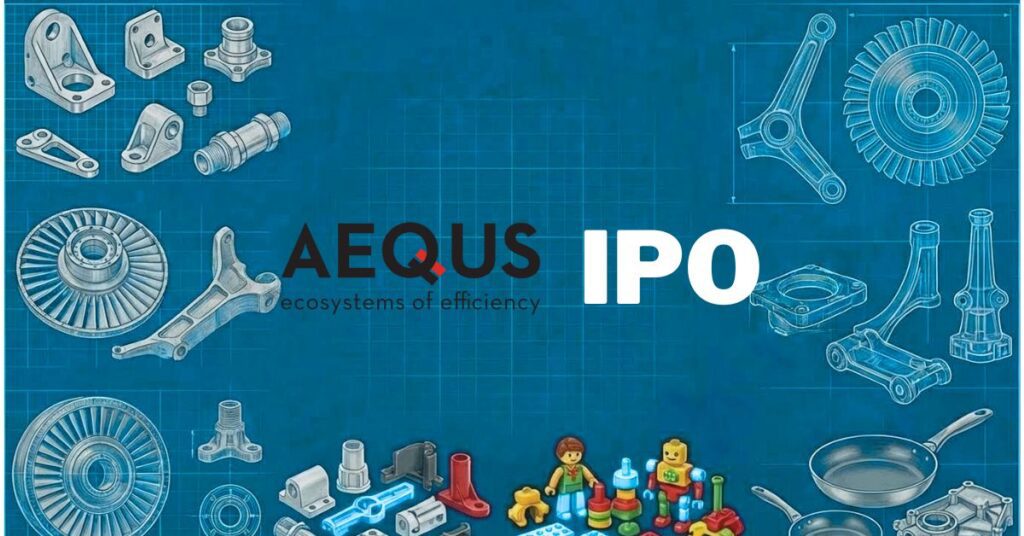
Aequs Limited is a diversified precision manufacturing company operating across the aerospace, consumer products, and plastics segments. The company is known for building one of India’s largest integrated manufacturing ecosystems with dedicated clusters in Belagavi, Hubballi, and Koppal.
The Aequs IPO is a ₹ 921.81 crore public issue, consisting of a ₹ 670 crore fresh issue and an Offer for Sale of 2.03 crore shares by existing investors. The price band has been fixed at ₹118 to ₹124 per share, with a lot size of 120 shares.
The IPO opens on 3 December 2025 and closes on 5 December 2025, with listing scheduled on both NSE and BSE on 10 December 2025. The company aims to use the funds from the fresh issue mainly to reduce debt and strengthen its balance sheet, supporting future growth in high-potential verticals like aerospace machining and consumer durable manufacturing.
Aequs has grown from a single-facility machining business into a global precision-engineering platform with operations in India, the U.S., and France. The IPO offers investors a chance to participate in India’s rising manufacturing momentum, backed by government initiatives such as Make in India, Aatmanirbhar Bharat, and growing demand from aerospace OEMs and large consumer brands.
About Aequs Limited
Founding and History
Aequs Limited began its journey in 2000 in Bengaluru under the name Mechanical Training Academy Private Limited. Over the next decade, it evolved from a small machining operation into a full-scale manufacturing company. As the business expanded, it underwent multiple name changes and finally adopted the name Aequs in 2014 to reflect its identity as a precision engineering and manufacturing ecosystem. In 2025, the company was converted into a public limited entity as it prepared for its IPO.
Business Model
Aequs operates an integrated manufacturing ecosystem focused on two major verticals: aerospace and consumer products. Its business model revolves around long-term supply contracts, multi-year production programs, and high-capex manufacturing clusters that support machining, molding, forging, assembly, and other value-added operations. This integrated approach enables reliable quality, speed, and scalability for global clients.
Brand & Market Positioning
Aequs positions itself as a global precision manufacturing partner with end-to-end capabilities across engineering, production, and finishing. The brand is strongly associated with India’s largest aerospace manufacturing ecosystem and is known for delivering high-quality components and assemblies to major international customers. Its integrated cluster model gives it a unique competitive advantage compared to traditional, fragmented manufacturers.
Products & Services
Aequs manufactures a wide range of engineered products across multiple domains:
• Precision machined components for aerospace engine systems
• Components for landing gear and structural assemblies
• Plastic molded parts for toys, electronics, and lifestyle brands
• Cookware, die-cast products, and home appliance parts
• Extruded aluminum products
• Value-added services such as machining, molding, forging, surface treatment, and tooling
These offerings are supported by dedicated facilities across its Indian clusters and international subsidiaries.
Flagship Products/Services
The company’s flagship capabilities lie in aerospace machining and assemblies, where it serves some of the world’s leading OEMs and Tier-1 suppliers. In the consumer segment, it is known for its large-scale toy manufacturing ecosystem in Koppal and its integrated plastics and cookware production capabilities.
Revenue Breakdown
Aequs earns revenue primarily from two segments: aerospace and consumer. The aerospace business contributes through machining, forging, and assembly of precision parts, while the consumer division generates revenue through plastics, toys, cookware, and appliance components. Segment-wise financials will be detailed in the Financial Performance section.
Geographical Footprint
Aequs operates major integrated clusters in Belagavi, Hubballi, and Koppal in Karnataka. In addition to its Indian operations, it has a global footprint with facilities in the United States and France, enabling it to supply both regional and international markets effectively.
Management & Promoters
The company is led by its promoter, Aravind Melligeri, who serves as Executive Chairman and CEO. He has been instrumental in building Aequs’ integrated manufacturing ecosystems. The promoter group also includes Aequs Manufacturing Investments Private Limited, Melligeri Private Family Foundation, and The Melligeri Foundation. The leadership team consists of professionals with expertise across aerospace, engineering, and large-scale manufacturing operations.
Corporate Structure
Aequs operates through a network of subsidiaries and joint ventures across different domains such as machining, plastics, aerospace processing, forging, molding, and consumer products. Key subsidiaries include entities in India, Europe, and the U.S., while joint ventures support specialized services like surface treatment and forging. Together, these entities form a vertically integrated supply chain.
Target Customers
Aequs serves global aerospace OEMs and Tier-1 suppliers as well as international consumer brands in toys, cookware, electronics, and home appliances. The company focuses on long-term strategic customers that value precision, reliability, compliance, and scalable manufacturing.
How They Make Money
The company generates revenue through manufacturing contracts, long-term supply agreements, and high-volume consumer product orders. Its integrated clusters allow it to capture value across multiple stages of production—machining, molding, finishing, assembly, and logistics—leading to operational efficiencies and higher throughput.
Market Share
Aequs is among India’s leading players in the integrated aerospace manufacturing space. Its large-scale clusters, multi-capability infrastructure, and global footprint give it a strong position in precision engineering. In the consumer division, Aequs is emerging as a significant player in toys, plastics, and cookware manufacturing with increasing market presence.
About Aequs IPO
The Aequs Limited IPO is a ₹ 921.81 crore public issue consisting of a ₹ 670 crore fresh issue and an Offer for Sale (OFS) of ₹ 251.81 crore by existing shareholders.
This IPO is managed by JM Financial, IIFL Capital Services, and Kotak Mahindra Capital as the Book Running Lead Managers (BRLMs). KFin Technologies Limited is the Registrar to the Issue.
The company has fixed the price band at ₹118 to ₹124 per share, with a lot size of 120 shares for retail investors. The IPO follows the 100% Book-Built route and will be listed on both the NSE and BSE.
The fresh issue proceeds will be used for repayment or prepayment of borrowings, working capital requirements, and general corporate purposes. These funds will support Aequs in strengthening its financial position and expanding capacity across its aerospace and consumer manufacturing clusters.
The IPO will open on 3 December 2025, close on 5 December 2025, and the company is expected to list its shares on 10 December 2025. Anchor bidding will take place on 2 December 2025, followed by allotment finalisation on 8 December 2025.
IPO Details
Issue Type: 100% Book-Built Issue
Total Issue Size: ₹ 921.81 crore
Fresh Issue: ₹ 670 crore
Offer for Sale (OFS): ₹ 251.81 crore
Price Band: ₹ 118 – 124 per share
Face Value: ₹ 10 per share
Lot Size: 120 shares
Minimum Retail Investment: ₹ 14,880
Listing: NSE & BSE
Pre-IPO Placement: ₹ 144 crore at ₹123.97 per share
Employee Reservation: ₹ 20 million with ₹11 per share discount
Book Running Lead Managers:
JM Financial Limited
IIFL Capital Services Limited
Kotak Mahindra Capital Company Limited
Registrar to the Issue: KFin Technologies Limited
IPO Timeline
Anchor Investor Bidding: 2 December 2025
Issue Opens: 3 December 2025
Issue Closes: 5 December 2025
Allotment Finalisation: 8 December 2025
Refunds Initiated: 9 December 2025
Shares Credited to Demat: 9 December 2025
Listing Date: 10 December 2025
Valuation Snapshot
Price Band: ₹118–124
Implied Market Cap: To be calculated from final post-issue share count
P/E Ratio: Not meaningful due to inconsistent profits
EV/EBITDA: Impacted by high capital expenditure and variable annual performance
Price-to-Sales (P/S): More relevant for valuation
Pre-IPO Placement Price: ₹123.97 (close to upper band)
Industry Overview
Aequs operates in the aerospace precision manufacturing and consumer contract manufacturing industries—two sectors that are growing quickly due to global outsourcing, rising domestic demand, and India’s push toward becoming a manufacturing hub. Aerospace production in India is strengthening due to defence indigenisation, aircraft order growth, and OEM vendor diversification. The consumer manufacturing sector—covering plastics, toys, cookware, and lifestyle goods—is expanding rapidly as brands shift supply chains to India under the China+1 strategy. Aequs benefits from both trends through its large, integrated manufacturing clusters.
Market Size and Growth
The Indian aerospace precision engineering market is expanding as global OEMs increase outsourcing to India.
The consumer manufacturing market (plastics, toys, cookware) is growing due to urbanisation, rising incomes, and export demand.
Government programs like Make in India, PLI, and Aatmanirbhar Bharat continue to accelerate industry-wide capital investment.
Key Market Trends and Growth Drivers
Increasing outsourcing by global aerospace OEMs and Tier-1 suppliers.
strong shift toward China+1 supply diversification in consumer goods.
Growth in domestic defence procurement and global aircraft deliveries.
Rising demand for high-quality plastics, toys, cookware, and moulded components.
Preference for large, integrated manufacturing ecosystems that reduce cost and lead times.
Sub-Sector Breakdown
Aerospace machining, structural assemblies, landing gear components, and engine system parts.
Surface treatment, forging, and mid-value aerospace processes.
Plastics molding for electronics, toys, and lifestyle brands.
Cookware, die-cast product manufacturing, and home appliance components.
Aluminum extrusion products for industrial and consumer applications.
Consumer and Merchant Behaviour Shifts
Aerospace customers prefer long-term partnerships with suppliers who offer scale, compliance, and process depth.
Consumer brands increasingly prefer manufacturers who offer end-to-end solutions: molding, painting, assembly, and packaging.
Strong domestic push toward import substitution in plastics and toys.
Rising demand for export-ready suppliers across multiple product categories.
Technological Innovation and Infrastructure
Adoption of advanced CNC machining, robotics, automated assembly lines, and precision tooling in aerospace.
Growth in high-speed molding, multi-cavity tooling, and automated painting systems in consumer manufacturing.
Aequs’ integrated clusters benefit from shared infrastructure, logistics, utilities, and industrial park efficiency.
Competitive Landscape
Aerospace machining is globally fragmented but dominated by certified precision manufacturers.
In India, only a few companies offer end-to-end aerospace manufacturing at significant scale.
Consumer plastics and toy manufacturing are competitive, but Aequs’ integrated setup provides cost and efficiency advantages.
Aequs’ multi-capability clusters create differentiation versus traditional standalone factories.
Regulatory Environment
Aerospace production requires strict global certifications, quality audits, and process compliance.
Plastics, toys, and cookware manufacturing require adherence to safety, environmental, and export compliance norms.
Government policies—PLI, defence procurement reforms, MSME incentives, and export support—strengthen industry fundamentals.
Global Perspective and Export Potential
India is emerging as a preferred global manufacturing hub due to competitive cost structures and skilled engineering talent.
Global OEMs are diversifying supply chains to reduce geopolitical dependency.
Demand for Indian-made toys, plastics, cookware, and engineered products is rising across the U.S., EU, and Middle East.
Aequs’ international presence in the U.S. and France enhances its ability to participate in global supply networks.
Future Outlook
Aerospace manufacturing is set to grow with rising aircraft deliveries and defence outsourcing.
Consumer manufacturing demand will increase with higher consumption, exports, and brand penetration.
Integrated manufacturing parks like Aequs’ clusters are expected to gain traction due to efficiency, cost savings, and scalability advantages.
Summary
Aequs operates in two high-growth industries supported by strong demand, supply chain shifts, and national manufacturing programs. Its integrated clusters give it structural advantages in scale, cost efficiency, and vertical capabilities. With rising global outsourcing and India’s growing role as a manufacturing alternative, Aequs is well-positioned to benefit from long-term tailwinds across aerospace and consumer product manufacturing.
Peer Analysis of Aequs IPO
Aequs operates across precision aerospace manufacturing and consumer contract manufacturing. For a meaningful comparison, the closest listed peers span both aerospace engineering and high-volume manufacturing.
Peers Considered
MTAR Technologies – Precision engineering, aerospace, defence
Dynamatic Technologies – Aerospace structures, engineering systems
Amber Enterprises – Contract manufacturing for consumer durables
Astra Microwave Products – Defence electronics and RF systems
Hindustan Aeronautics Limited (HAL) – India’s largest aerospace manufacturer
Market Capitalisation
Aequs: To be determined post-IPO
MTAR: ~₹ 8,000 crore
Dynamatic: ~₹ 6,000 crore
Amber: ~₹ 10,000 crore
Astra Microwave: ~₹ 4,000 crore
HAL: ~₹ 3,00,000 crore
P/E Ratio
Aequs: Not applicable due to losses
MTAR: High, growth-driven
Dynamatic: Very high, volatile earnings
Amber: High, consumer premium
Astra Microwave: Moderate, steady demand
HAL: Low–Moderate, strong profitability
EV/EBITDA
Aequs: Elevated (high capex + leverage)
MTAR: Moderate
Dynamatic: High
Amber: High
Astra Microwave: Moderate
HAL: Low
Business Scale / Production Value
Aequs: Aerospace + Plastics + Toys + Cookware
MTAR: Aerospace & clean energy components
Dynamatic: Aerospace structures
Amber: Consumer appliances
Astra Microwave: Defence communication systems
HAL: Full aerospace platform production
Margin Profile
Aequs: Thin-to-moderate, cyclical
MTAR: Strong
Dynamatic: Moderate
Amber: Low–moderate
Astra Microwave: Strong
HAL: Very strong
Active Clients
Aequs: Aerospace OEMs + global consumer brands
MTAR: ISRO, DRDO
Dynamatic: Airbus supply chain
Amber: LG, Daikin, Voltas
Astra Microwave: Defence PSUs
HAL: Indian Armed Forces + global OEMs
FY24 Revenue
Aequs: Lower vs peers
MTAR: Moderate
Dynamatic: Moderate
Amber: Highest among peers
Astra Microwave: Moderate
HAL: Extremely high
FY24 Net Profit
Aequs: Inconsistent
MTAR: Strong
Dynamatic: Weak
Amber: Moderate
Astra Microwave: Strong
HAL: Very strong
EBITDA Margins
Aequs: Volatile, high depreciation
MTAR: Strong
Dynamatic: Moderate
Amber: Low
Astra Microwave: High
HAL: Very high
Debt Strength
Aequs: High leverage
MTAR: Low
Dynamatic: High
Amber: High
Astra Microwave: Low
HAL: Very low
Product Breadth
Aequs: Aerospace + Plastics + Toys + Cookware
MTAR: Precision components
Dynamatic: Aerospace + Auto
Amber: Consumer electronics
Astra Microwave: Defence electronics
HAL: Aircraft, helicopters, engines
Geographic Diversification
Aequs: India, U.S., France
MTAR: India + exports
Dynamatic: India + UK + Germany
Amber: India + exports
Astra Microwave: Mostly India
HAL: Global defence partnerships
Technology & Innovation Strength
Aequs: Strong cluster-based automation
MTAR: Deep precision machining
Dynamatic: Advanced aerospace structures
Amber: OEM-integrated engineering
Astra Microwave: RF/microwave innovation
HAL: Highest level aerospace R&D
Partnerships & Ecosystem Strength
Aequs: Long-term OEM supply programs + integrated clusters
MTAR: ISRO/DRDO partnerships
Dynamatic: Airbus-linked supply chain
Amber: Consumer OEM alliances
Astra Microwave: Defence PSU ecosystem
HAL: Strategic national importance
Revenue Mix
Aequs: Aerospace + Consumer
MTAR: Aerospace + Clean Energy
Dynamatic: Aerospace + Auto
Amber: Consumer Durables
Astra Microwave: Defence Electronics
HAL: Aircraft, Engines, MRO
Order Book Strength
Aequs: Healthy long-term aerospace + consumer contracts
MTAR: Strong multi-year defence/space projects
Dynamatic: Dependent on Airbus cycle
Amber: Seasonal consumer demand
Astra Microwave: Stable defence orders
HAL: Exceptional, multi-year government backlog
Customer Concentration Risk
Aequs: High in aerospace OEMs
MTAR: Moderate
Dynamatic: Very high
Amber: Moderate-high
Astra Microwave: Moderate
HAL: Low
Certifications & Compliance Strength
Aequs: AS9100, NADCAP, global OEM approvals
MTAR: Defence & aerospace certifications
Dynamatic: Airbus-approved systems
Amber: Consumer-grade compliance
Astra: Defence communication certifications
HAL: Complete aerospace/defence compliance
Manufacturing Integration Depth
Aequs: Complete value chain (machining → forging → molding → assembly)
MTAR: Strong machining integration
Dynamatic: Aerospace structures
Amber: Vertical integration in appliances
Astra: Electronics assembly
HAL: Full-cycle aerospace integration
Capex Intensity
Aequs: Very high
MTAR: High
Dynamatic: High
Amber: Moderate
Astra: Moderate
HAL: High
Export Dependency
Aequs: High
MTAR: High
Dynamatic: High
Amber: Moderate
Astra: Low–moderate
HAL: Moderate
Cluster Advantage Index (Aequs-only strength)
Aequs: Strongest cluster-based model in India
Others: No comparable integrated ecosystem
Key Insights
Aequs is uniquely diversified, combining aerospace machining with large-scale consumer manufacturing — no peer matches this mix.
Profitability lags peers due to high leverage and capex intensity.
Aerospace peers like HAL and MTAR outperform Aequs on margins, stability, and order book strength.
Aequs’ cluster model is a long-term structural advantage that can unlock scale efficiencies not available to other players.
Customer concentration risk is highest for Aequs and Dynamatic, typical for aerospace suppliers.
Amber dominates consumer manufacturing, but Aequs’ multi-vertical presence adds diversification potential.
For investors, Aequs represents a high-opportunity, high-risk precision manufacturing play.
Aequs IPO Reservation
| Application Category | Maximum Bidding Limits | Bidding at Cut-off Price Allowed |
|---|---|---|
| Only RII | Up to Rs 2 Lakhs | Yes |
| Only sNII | Rs 2 Lakhs to Rs 10 Lakhs | No |
| Only bNII | Rs 10 Lakhs to NII Reservation Portion | No |
| Only employee | Up to Rs 5 Lakhs | Yes |
Aequs IPO Lot Size
| Application | Lots | Shares | Amount |
|---|---|---|---|
| Retail (Min) | 1 | 120 | ₹14,880 |
| Retail (Max) | 13 | 1,560 | ₹1,93,440 |
| S-HNI (Min) | 14 | 1,680 | ₹2,08,320 |
| S-HNI (Max) | 67 | 8,040 | ₹9,96,960 |
| B-HNI (Min) | 68 | 8,160 | ₹10,11,840 |
Financials of Aequs Limited
| Period Ended | 30 Sep 2025 | 31 Mar 2025 | 30 Sep 2024 | 31 Mar 2024 | 31 Mar 2023 |
|---|---|---|---|---|---|
| Assets | 2,134.35 | 1,859.84 | 1,863.50 | 1,822.98 | 1,321.69 |
| Total Income | 565.55 | 959.21 | 475.51 | 988.30 | 840.54 |
| Profit After Tax | -16.98 | -102.35 | -71.70 | -14.24 | -109.50 |
| EBITDA | 84.11 | 107.97 | 57.82 | 145.51 | 63.06 |
| NET Worth | 796.04 | 707.53 | 731.65 | 807.17 | 251.91 |
| Reserves and Surplus | 200.43 | 135.09 | -90.83 | -15.31 | -146.15 |
| Total Borrowing | 533.51 | 437.06 | 384.79 | 291.88 | 346.14 |
The company reported inconsistent revenue performance over the last three years due to cycles in aerospace demand and the ramp-up phase in its consumer manufacturing divisions.
Aequs posted operating losses in FY23 and FY25, while FY24 showed an improvement in operating profitability, supported by better utilisation and higher contribution from consumer manufacturing.
The company’s net profit remained negative across multiple years, reflecting high depreciation, high finance costs, and the capital-intensive nature of its integrated clusters.
Aequs carries significant debt, which increases interest outflows and puts pressure on overall profitability; a part of the IPO proceeds will be used for debt reduction.
EBITDA margins remain volatile, impacted by lower utilisation in aerospace machining and fluctuating consumer demand.
The company continues to make heavy investments in capex, especially in forging, plastics, and cluster expansion, which has long-term potential but short-term profitability impact.
Overall, the financial profile reflects a growth-phase manufacturing business with long-term opportunity but near-term pressure due to leverage and scaling costs.
Objective of Aequs IPO
Aequs Limited intends to use the proceeds from the ₹ 670 crore fresh issue for the following purposes:
Repayment or prepayment of borrowings, which will help reduce interest costs and strengthen the company’s balance sheet.
Funding working capital requirements, especially for its aerospace, plastics, toys, and consumer manufacturing divisions.
Supporting general corporate purposes, including operational flexibility, cluster expansion, and capacity enhancement across existing facilities.
Overall, the IPO aims to improve Aequs’ financial stability, support growth in both aerospace and consumer manufacturing, and enhance long-term operational efficiency.
SWOT Analysis of Aequs IPO
Strengths
Integrated manufacturing clusters across Belagavi, Hubballi, and Koppal provide scale, cost advantages, and end-to-end capabilities.
Diverse business portfolio covering aerospace machining, forging, plastics, toys, and cookware reduces dependency on a single segment.
Strong global customer relationships with established aerospace OEMs and international consumer brands.
Comprehensive certifications such as AS9100 and NADCAP enhance credibility in the global aerospace supply chain.
International footprint in the U.S. and France strengthens global reach and supply chain integration.
Weaknesses
Inconsistent profitability over the last few years due to high depreciation, interest costs, and cyclical demand.
High leverage, resulting in substantial finance costs and pressure on cash flows.
Lower utilisation in aerospace operations, leading to margin volatility.
Customer concentration risk, particularly in the aerospace segment where few clients contribute significantly to revenue.
High capex intensity, making the business dependent on long-term volume commitments.
Opportunities
Strong growth in India’s aerospace sector, driven by commercial and defence demand.
Rising global outsourcing, with OEMs shifting work to India under China+1 strategies.
Expansion of consumer manufacturing, especially toys, plastics, and cookware, where India is becoming a preferred global sourcing base.
Government incentives through Make in India, PLI schemes, and defence indigenisation.
Scaling benefits as Aequs’ integrated clusters mature and utilisation levels improve.
Threats
Cyclicality in global aerospace demand, impacting machining volumes.
Foreign exchange volatility due to high export dependence.
Competitive pressures from established global aerospace suppliers and domestic consumer manufacturers.
Regulatory and certification risks, especially in aerospace where compliance requirements are stringent.
Execution risk in managing large-scale capex and cluster expansion while maintaining profitability.
Disclaimer: Market Insiderz is not a SEBI registered investment advisor. The information provided here, including GMP, is for educational purposes only and subject to market volatility. Please consult a certified financial advisor and read the RHP carefully before investing.
FAQ on Aequs IPO
The Aequs IPO is a ₹ 921.81 crore public issue that includes a ₹ 670 crore fresh issue and an OFS of ₹ 251.81 crore. The company operates across aerospace machining, plastics, toys, cookware, and large-scale contract manufacturing.
The Aequs IPO Price Band is ₹118 to ₹124 per share.
Retail investors must apply for a minimum of 120 shares, and additional bids must be in multiples of 120.
The Aequs IPO opens on 3 December 2025 and closes on 5 December 2025.
The Aequs IPO Allotment Date is expected to be 8 December 2025.
The shares are proposed to list on 10 December 2025 on both NSE and BSE.
The Aequs IPO GMP (Grey Market Premium) changes frequently and is not officially provided by the company. Investors should rely on fundamentals instead of unofficial GMP figures.
The IPO aims to reduce the company’s debt, support working capital needs, and fund general corporate purposes that help scale operations across its aerospace and consumer manufacturing clusters.
The Book Running Lead Managers are JM Financial, IIFL Capital Services, and Kotak Mahindra Capital Company Limited.
KFin Technologies Limited is the Registrar to the Issue.
A retail investor must invest at least ₹ 14,880 at the upper price band.
No. The company has reported inconsistent profitability due to high depreciation, interest costs, and significant capital expenditure.
Conclusion
Aequs Limited brings a unique combination of aerospace precision manufacturing and large-scale consumer contract manufacturing, supported by its integrated cluster model across Karnataka. The company’s long-term growth potential is linked to global outsourcing, India’s rising role in aerospace, and the expansion of consumer goods manufacturing.
However, investors must consider the company’s inconsistent profitability, high leverage, and the capital-intensive nature of its operations. These factors make the IPO better suited for investors with a long-term outlook and a higher risk appetite.
The pricing reflects the company’s future potential rather than current financial strength. Those confident in India’s manufacturing story—especially aerospace and export-oriented consumer products—may find Aequs’ integrated ecosystem compelling. Conservative or short-term investors may prefer to evaluate the company’s performance post-listing and after utilisation levels improve.
Aequs is ultimately a growth-driven, high-potential, high-risk manufacturing play in a sector where India is rapidly gaining global relevance.